Friday, 17 November 2017

All About Eve 1950

The Film:

I've been looking forward to this one. It's one of my favourites but I haven't seen it for a while so it's going to be great!

As is possibly the case for other 40-something Brits, I first came across this film because one of my favourite 80s bands named themselves after it. My first associations with All About Eve were all long hair and dresses, folk goth in clouds and forests etc. The band members clearly had great taste in movies, but the film itself bares no resemblance to the band's image! (On a similar note, I really should watch Hue and Cry one of these days....)

There is so much to love about All About Eve - and I'm sure I'll discover much more to ramble on about in my review. I love George Sanders' character (as I think I said ten films ago about Rebecca!), but other than that this is all about the women. There are five of them that are quite magnificent (I include young Marilyn in that line up because she's fabulous in a relatively short space of time!) and this is almost unheard of even in films today. Forty years later people raved about the two strong female leads in Thelma and Louise and how they didn't take any nonsense from their men. And sixty-six years later a similar fuss was made about the three women in Hidden Figures because it was still so unusual. And yet here we are in 1950 with the women completely in charge - and the men not really seeming to mind too much!
The Ceremony:

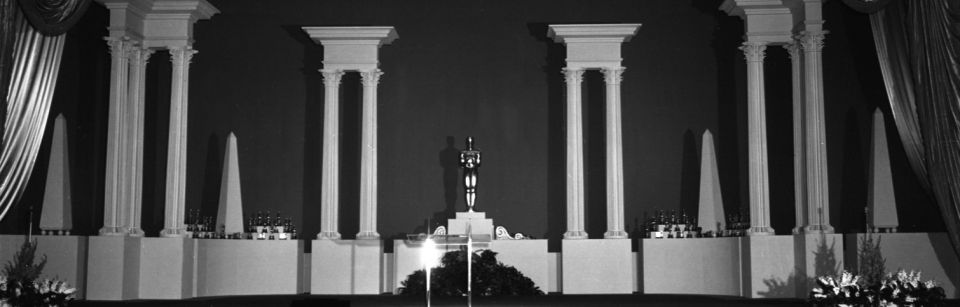
The stage is set.....
The ceremony was held on March 29th 1951 at the Pantages Theater and was hosted by Fred Astaire. It was filmed in colour and there are loads of clips of it on Youtube. Now that the 50s are kicking in things are starting to look more and more like the more modern Oscar ceremonies I've grown up with.

The nominations were dominated by two films - All About Eve and Sunset Boulevard - that had 25 nominations between them, including nine acting nominations across the four categories. Both of these films, like the previous few years' winners, were very much led by the script and the acting rather than any other spectacle (unlike our next two films!). And both were directed by their scriptwriters (both of whom are multiple Oscar winners). It's a bit of a shame that they were up against each other.


Other Notable Winners That Night:


Gloria Swanson being gracious in defeat, with Jose Ferrer
and Judy Holliday
The acting nominations were dominated by the big two films. SB had one nomination in each category. AAE had two in each Actress category and Supporting Actor for George Sanders. Out of all of those, Sanders was the only one who took the Oscar home.

Judy Holliday won Best Actress for Born Yesterday. Some people claim that Anne Baxter's insistence that she was nominated as a lead rather than in Supporting lost both her and Bette Davis an Oscar as they split the vote. But I can't for the life of me work out why Gloria Swanson didn't get it! (I haven't seen Judy's performance - but I've ordered the DVD so maybe I'll edit this after I've watched it!)

Jose Ferrer took Best Actor for Cyrano de Bergerac and 73 year old Josephine Hull trumped Celeste Holm and Thelma Ritter to take Best Supporting Actress for Harvey (I love that film - she's great in it, so fair enough....) Joseph L Mankiewicz took writing and directing awards for the second year running - interestingly, both times these were for films with strong female leads (- and Celeste Holm!)

The animation award this year went to a classic that I remember from my childhood (so it, and its followups, must have been shown a lot in the 70s!) and it's all here on Youtube. The great Gerald McBoing-Boing:


Best Song:

This year it's Mona Lisa from the film Captain Carey USA. Again, I know the song well but not the film. The film was an Alan Ladd post-war drama. The song was a big chart hit of the year for Nat King Cole and became a classic for him - but it was sung in the film by Charlie Spivak and I've found a clip of it in its original setting!:


What We Could/Should Have Been Watching:

"I'm ready for my Oscar Mr de Mille!"
There are some good films on the list this year. King Solomon's Mines is a big sweeping epic, Father Of The Bride is a great comedy (that has since been remade, with a sequel!) and Born Yesterday, though not one I've seen, sounds good and I will check it out.

As an avid fan of All About Eve there is no doubt in my mind that the right film won - but this is one year where I really wish they had given two Best Picture awards, because the other nominee was Sunset Boulevard. Gloria Swanson should have at least won the Best Actress award - and in almost any other year, Billy Wilder should have got Director as well as screenplay (thankfully there are two screenplay awards - so Wilder and Mankiewicz got one each!). It's a wonderful film and I watched it again last week anyway, just because!

Our Verdict:
One of my favourite scenes in the film - the writing, the acting,
the timing all brilliant.
This film is all about the characters. They are written brilliantly and they are played superbly. And that is what makes it such a good film.

The basic plot - Bette Davis plays Margot, an aging actress who is still playing leading roles but is starting to get bitter at the fact that she's growing older. Thelma Ritter is her dresser/assistant Birdie (who weirdly disappears for the last third of the film, which is a real shame.)
Margot and Birdie - and dialogue that could cut diamonds!

Anne Baxter is the titular Eve, a young fan who works her way into Margot's world ready to take over. Celeste Holm is Karen, the wife of a playwright who is a close friend of Margot's and first introduces her to Eve. George Sanders is theater columnist Addison deWitt who basically serves as, for want of a better word, the catalytic s**t-stirrer that encourages events to unfold a certain way. There are other male characters - Lloyd the aforementioned playwright, Margot's boyfriend Bill who is a Director and Producer Max. They play their parts well and serve their purpose (I particularly like Bill!) but they are all there to support the main point of the story, which is all about the relationships between the women in the cast. And the whole thing is wonderfully refreshing because of it!

George and Marilyn - the not-as-clever-as-he-thinks leading
the not-as-dumb-as-she-seems.
There's also Marilyn Monroe in an early role as a young starlet that Addison brings to Margot's party. She provides a lovely glimpse at what she did best - play a so-called "dumb" blonde in a subtly comic and incredibly intelligent way. (My favourite Monroe films are Some Like It Hot and Gentlemen Prefer Blondes - and her performance here almost serves as an audition for Sugar and Lorelei!).

Another example of the corruption that goes along with power?
The pacing of the film is great, with the gradual revelation and unravelling of their lives, attitudes and motives. Margot gets gradually more bitter and paranoid, Karen gradually realizes how much her kindness is being taken advantage of - and Eve gradually reveals her true nature. With everything watched by the (almost) all-seeing eye of Addison - who generally enjoys the whole drama of it, definitely enjoys trying to play Eve at her own game, yet is ever so slightly appalled by the whole thing (although I'm guessing some people would disagree with that last point?).

And the ending is great! Just as with All The King's Men last time, it would be wrong for me to give anything away. But it is very satisfying indeed and serves as a great big cherry on the top of a deliciously tasty treat of a cake.

This is one of my favourite films of all time - if you haven't seen it, please give it a go. If you have, then it's probably worth watching again soon. The internet is full of people arguing about the relative merits of All About Eve and Sunset Boulevard. I love Billy Wilder (and I still think that dodgy insurance man put on a better show than those priests in 1944!) but, in this debate, I'm definitely All About Eve!

Wednesday, 15 November 2017

Review of the 40s

The 40s - The War Years and Beyond

We have really enjoyed watching the 40s! So much so that I don't really want to move on - I keep watching other 40s films and could happy stay here for a while longer. With this decade there were five films I'd already seen (two of which are favourites - and still sit in first and second on my chart) and five films that I'd not seen before. Of those five I can recommend four wholeheartedly. I loved them and will definitely watch them again. But, although friends of mine love it, I couldn't get my head round How Green Was My Valley. Maybe I'm not as Welsh as I claim to be, or maybe I am and that's the problem!

With these films we got through the War and out the other side - and we got through the Hays Code and out the other side as well. The former is very clear when you list the winners chronologically. The latter is far clearer when you look more widely at the nominees - films like Johnny Belinda, Crossfire and The Snake Pit would not have been possible ten years earlier!

My Top Ten (as they stand today!) is as follows:

1= Rebecca
1= Casablanca
3= The Best Years of Our Lives
3= The Lost Weekend
5. All The King's Men
6. Mrs Miniver
7. Hamlet
8. Going My Way
9. Gentleman's Agreement
10. How Green Was My Valley

(I'm finding those top films very difficult to split!)

Best Picture

Nominees:   

Rebecca
Casablanca
The Best Years of Our Lives
The Lost Weekend
All The King's Men

And the winner is.....

Rebecca - although all five of these are very good films indeed! Rebecca has been a favourite for a very long time and it just about pips Casablanca for me. On a different day I might have to cheat and give them both the prize!


Best Director

Nominees:   

William Wyler
Alfred Hitchcock
Billy Wilder
Michael Curtiz
Laurence Olivier

And the winner is.....


William Wyler - for topping and tailing the War so splendidly! Hitch and Wilder are personal favourites of mine, but they both miss out on this one....

Best Actor


Nominees:   

Barry Fitzgerald (How Green Was My Valley, Going My Way)
Ray Milland (The Lost Weekend)
Frederic March (The Best Years of Our Lives)
Laurence Olivier (Rebecca, Hamlet)
Broderick Crawford (All The King's Men)

And the winner is.....

Frederic March - just about stealing it from Ray Milland, because he was brilliantly comic and tragic all at the same time.


Best Actress


Nominees:   

Greer Garson (Mrs Miniver)
Joan Fontaine (Rebecca)
Myrna Loy (The Best Years of Our Lives)
Ingrid Bergman (Casablanca)
Mercedes McCambridge (All The King's Men)

And the winner is.....

Greer Garson - just about stealing it from Joan Fontaine. Just as long as we don't have to endure her speech again.


Best Non-Winning Picture


Nominees: 

Citizen Kane
It's A Wonderful Life
Double Indemnity
The Philadelphia Story
Brief Encounter

And the winner is.....

Citizen Kane AND It's A Wonderful Life - The first because it really really should have won, and the second because I love it!


Worst Picture

Nominees:    
How Green Was My Valley
Gentleman's Agreement


And the winner is.....

How Green Was My Valley - There really were only two mediocre films out of this lot and How Green... gets it (just about) for the bad accents and meandering plot!


All The King's Men 1949

The Film:

This is the film on the whole list of nearly ninety films that I probably knew least about. It would be my best bet for a Pointless answer as, for some reason, nobody seems to remember it.

I had to do some digging to get hold of a copy - and eventually got one from Poland. The spine of the DVD says "Gubernator" as the title - which gives a bit more of a clue as to what the film is about.

I did a bit more digging around Wikipedia and IMDB to find out a bit more. I don't really recognise the names of any of the lead players (except Mercedes McCambridge, who I know from her most famous line, which isn't quite "Your mother cooks socks in hell" - but I would never have been able to pick the voice of the demon in The Exorcist out of a visual line up!). Reviews on IMDB rate the film very highly, along with its Pulitzer Prize-winning source novel.

This left me wondering. Did I just have a random glaring gap in my movie knowledge - or is there some other reason why this film is pretty much forgotten?

The Ceremony:

Held on March 23rd 1950 at the Pantages Theater and hosted by Paul Douglas, who was one of the stars of multiple nominee A Letter To Three Wives.

I don't have any more interesting information about the ceremony - except for the fact that this is (and probably will remain) the last year that all the Best Picture nominees were in black and white - the end of the 40s definitely marked the end of a particular style of film making and the start of the domination of sweeping technicolor spectaculars!


Other Notable Winners That Night:
The Acting Awards (you can work out who is who!)

The Best Actor and Best Supporting Actress went towards the total of three awards for All The King's Men.


Olivia de Havilland won her second Oscar for The Heiress, which had been tipped to win more of the big prizes that night. Best Supporting Actor was Dean Jagger (a classic Hollywood character actor) for 12 O'Clock High.

Joseph L Mankiewicz won two awards - director and screenplay - for A Letter To Three Wives. And we'll come back to him again next year....)

The Honorary Awards are interesting this year. Jean Hersholt won his, six years before he had one named after him. And Ginger Rogers presented one to Fred Astaire!

Best Song:

I know this one - Baby It's Cold Outside - because it's one that hasn't really gone away and has since become a bit of a Christmas classic. (The Tom Jones and Cerys Matthews version comes to mind first). I'd never heard of the film it came from - Neptune's Daughter - a late era Esther Williams musical which is probably quite good fun (and, no doubt, wet in parts). Here's the song in its original context:


What We Could/Should Have Been Watching:

"I'm running off with your husband - but which one?"
This is the first year for a very long time (since the early 30s) where not only had I not seen any of the other nominees, I hadn't even heard of them.

I've found out very little about "Battleground" or "Twelve O'Clock High" except that they are both war films that don't sound particularly interesting to me.

The other two sounded interesting - "The Heiress" is based on a Henry James novel and won Olivia de Havilland the Best Actress Oscar. And "A Letter To Three Wives" won Best Director and was many people's tip for the big prize. I found the whole of the latter on Youtube and watched it the day after we watched All The King's Men. I think the right film won - but I really enjoyed "...Three Wives" and I'm glad I found out about it and got chance to watch it!

Our Verdict:
An honest Politician?
It's been a week or so now since we saw the film, and I'm still thinking about it off and on. Andy is doing the same, only more so. He absolutely loved it, has it right up there with Casablanca and Rebecca on his 40s list and is now really keen to read the book (so that's one Christmas present sorted).

I really liked this film and it's left me wondering even more why it is so forgotten. Maybe it would be played more if it was in colour? Or had the name of a more enduring star or director attached to it? Or maybe it's the subject matter that put it off limits a bit too much in the politically sensitive decades that followed in America. Whatever it is, so many people are missing out by not watching it!
Josh Lynam and Sam Seaborn from another era.....

It's based on a novel of the same name which, itself, is loosely based on the story of 1930s Governor Huey Long. To say too much about what happened to Gov Long would be to give away the ending of this film, but our protagonist here, Willie Stark, has a very similar career and one which ends in the same way.

The basic plot is the story of small-town, self-educated man-of-the-people Willie Stark who runs unsuccessfully in a local election but is picked up by some lobbyists (headed by Oscar-winning McCambridge) as a fall guy in a bigger election to basically split the vote and let their guy win. All this is being followed by a journalist who lets on to Stark what the deal is and ultimately quits his job and helps him to become Governor himself.

"We want Willie!"
Despite his initial ideals, Stark becomes a living example of the truism that "power corrupts and absolute power corrupts absolutely". He becomes more and more driven to achieve his political ideals by whatever means, fair or (more usually) foul - and he drags his team down with him.


Men and power and women - same as ever!
I'm not going to provide any spoilers here - so I'll go on to say that this story was told brilliantly. The acting, the script, the pacing of events, the black and white cinematography. All of it is done superbly. Stark's key followers are all great characters - their various motivations, and the different points at which the penny drops for them and they try to back off are shown so well and are so believable. The various strands of the conclusion that the film comes to are woven cleverly so that watching the film becomes a very satisfying experience.

One of the most impressive things about this film is also one of the saddest and most disturbing - even though it is nearly seventy years old, it is incredibly relevant to today's world and the way power is used and abused in modern society. The weekend that we watched the film was the same weekend that the Harvey Weinstein revelations were gathering momentum - and there's Willie Stark giving us a few examples of exactly that sort of behaviour! And, of course, the current tenant of The White House is also an outsider and a "man of the people". As to whether he's as corrupt as Willie Stark or not - (to quote someone else who appears to have been abusing his power) I couldn't possibly comment!


Friday, 10 November 2017

Hamlet 1948

The Film:
The "screenplay" to this one is, in my humble opinion, one of the greatest things ever written in the English language. And I know it very well indeed. After studying it for A Level and seeing it live on several occasions I can literally recite great chunks of it.

I've seen Mark Rylance, Alan Rickman and David Tennant perform it live and in person. I've seen Rory Kinnear and Benedict Cumberbatch perform it live via satellite. I've seen it performed interactively in the grounds of Helsinor Castle (I was even Rosencrantz at one point) And I've seen both the Zeffirelli/Mel Gibson and Kenneth Branagh films of it more often and more recently than I've seen this classic version.

This was the second time in three years that Laurence Olivier was nominated for producing and starring in a Shakespeare film. Last time (for Henry V) he lost out on both to Best Years of Our Lives. This time he won both (and was also nominated for Best Director - although John Huston denied him the triple)

Alas poor Oscar....
I remember watching this a long time ago, before I became such a Hamlet expert / obsessive / bore (delete as appropriate) but I don't remember a great deal about it. It runs longer than the Zeffirelli mish-mash but a good hour and a half shorter than Branagh's overblown "complete" version. I'm intrigued to find out what has and hasn't been cut (other than the famously absent Rozencrantz and Guildenstern). I'm expecting it to be very hammy and of its time. I'm hoping to be impressed though. And I'm probably going to be unsufferable throughout......

The Ceremony:

The ceremony took place at The Academy Theater on March 29th 1949 and was hosted by Robert Montgomery. It was a smaller event than the previous few years, mainly because a lot of the major studios had withdrawn financial backing - due to rumours that this financial support was effectively buying votes!

Johnny Belinda was the big film talked about in the lead up to the ceremony - with twelve nominations (although it only won one).

The Treasure of the Sierra Madre was the other big favourite - although Humphrey Bogart didn't get an Actor nomination for it, which is now considered to be one of the biggest snubs in the history of the awards.


Other Notable Winners That Night:


Keeping it in the family!
To a certain extent it was Larry's night - but the Huston family also did pretty well. John won Director and Screenplay, and his dad Walter won Best Supporting Actor. John also directed Clare Trevor to her Best Supporting Actress award, for Key Largo.


Jane Wyman won Best Actress - the only award that Johnny Belinda won. She is also only the second actress to win the award without speaking a word of dialogue (the first was Janet Gaynor - and she was only silent because the film was!)


Best Song:

"Buttons and Bows" from The Paleface - which was sung by Bob Hope who, unusually, wasn't hosting that night and didn't sing it live at the ceremony (his co-star Jane Russell sang it instead).

This is another thing (alongside a dissection of Casablanca) that pops up in Series 3 of Frasier. In fact, it's the main place that I know the song from. Frasier does a stunningly bad performance of it at a pledge drive.

(Oddly, a couple of episodes later, Frasier also goes on a fruitless quest to sit quietly and watch How Green Was My Valley. Quite an obsession going on with 40s Oscar winners that series....)


What We Could/Should Have Been Watching:

She should have bought some Skechers - I think
they do them in red....
It's a strong list this year. Which makes the dominance of a fairly low key bit of Shakespeare quite curious (was it a case of Americans loving jolly old England, or just the feeling that it was about time they gave Larry something?)

Apart from The Snake Pit (which sounds interesting, but it's not one that I've ever heard of) the other
nominees are classics that have stood the test of time. Johnny Belinda is a really good film on an important (particularly in light of current Hollywood issues!) and previously Hays Code banned theme. The Treasure of the Sierra Madre is a classic Hollywood epic. Both of these got some big awards elsewhere (where they most deserved them). However, I'm going to cast my vote for the other British film on the list - The Red Shoes. It won for Score and Art Direction (which makes sense). It should have won more. Michael Powell never won an Oscar (Pressburger got a writing one for 49th Parallel) - I'm happy to give him one of Larry's!

Our Verdict:
Well it didn't look like this when we were there this summer!
Polonius -  a brilliantly bumbling bore
I was worried. I was very worried. Partly because I know that I have high standards when it comes to Hamlet, and that even the late great Alan Rickman was only passable in a pretty awful production I spent a fortune on as a student. And partly because I was dreading the stilted luvvie-ness of the whole thing. Lots of people in inappropriate tights, freezing their codpieces off in the Scandinavian weather with incredibly RP over-the-top proclamations hither and thither.

There was plenty of all of that - but I needn't have worried. After the stagey strutting of the guards in the opening scene and the ridiculously louche way in which Larry was draped over his chair at dinner, everything started to get going and it was (for the most part) the Hamlet I know and love!

I learned to cope with the fact that Hamlet was nearly twice the age that he should have been (and clearly older than his mother!) and I got past the tights and strutting (and the anachronistic hair gel that both Horatio and Laertes seemed fond of.) And Larry's peroxide bowl-cut for that matter (they could have done with a better hair dresser!). Generally, the acting was very good, the staging was very good - and the pacing was very good.

Surprisingly, I didn't miss Rozencrantz and Guildenstern - but I did miss the "What a piece of work...." speech which was cut along with them. And I missed Fortinbras - he would have made for a better ending than just wet Horatio standing there with his hair gel!
Bona Shakespeare - here's Julian, looking for Sandy

It took a little while to get going - but from the point at which Hamlet sees his father (not just in his mind's eye) to brilliantly creepy effect, I got sucked in as usual to the whole thing. And it got better and better as it went on.

Ophelia was neither here nor there, and she did whine on a bit too much - but her father was rather splendid and delivered his bumbling waffle with a great mix of humour and pathos.

Gertrude and Claudius did the job well enough (although I would have liked more oomph from Claudius!) - but, apart from Larry itself, it's the smaller roles that made the difference.
Ey up Yorick, ows tha bin?

Stanley Holloway had a fab cameo as the Gravedigger and played the part well (basically, as Stanley Holloway!) - and the players were also great. (That whole scene worked really well).

Peter Cushing played the often-cut Osric - and put his heart and soul into a brilliantly comically camp performance. I thought he was going to irritate me, but he got away with it.

Larry showed why he was considered such a great actor by holding the whole thing together with such a great performance that the blonde-ness and the tights stopped distracting me after the first couple of scenes. I love Hamlet, and I love to pick it to pieces and be critical. Mark Rylance was my first, and he'll always be my favourite (closely followed by David Tennant) - but I really enjoyed this version, and I think I'd rather watch this one again over Gibson or Branagh. The play's the thing....and this thing is rather good!

Sunday, 5 November 2017

Gentleman's Agreement 1947

The Film:

I've seen this one before, quite a while back, as it's one of the films in my "Classic Hollywood" box set (along with How Green Was My Valley).

I remember quite liking it. I remember being quite shocked at how ridiculous the US attitude to American Jews was, especially so soon after a war we fought in order to protect their families (among other things). I'm slightly less naive about such things now, and so I'm keen to see the film again and form another opinion of it.

What I hadn't realised last time I watched it is that it features one of Hollywood's best child actors - Dean Stockwell, who I am far more familiar with as the much older character of Al from Quantum Leap. It also features actress June Havoc, who is better known (at least to Musicals fans) as Baby June, younger and blonder sister of Gypsy Rose Lee. I don't think I've seen her in anything else.

The Ceremony:

$6! Times have changed......
The ceremony took place at the Shrine Auditorium on March 20th 1948 (as you can see from the ticket!). It was hosted by Agnes Moorehead and Dick Powell - the first to have a female host!

The awards were spread around more than in most years, with no movie getting more than three Oscars. It is also (at time of writing) the most recent ceremony where all the acting nominees are now deceased.


Other Notable Winners That Night:


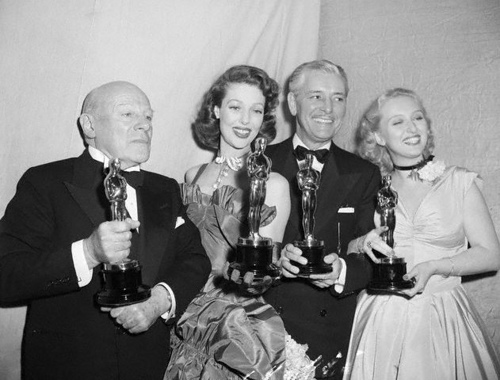
Edmund Gwenn, Loretta Young, Ronald Colman, Celeste Holm
The acting awards were shared between four different films this year - with each of the recipients winning their only Oscar.

Edmund Gwenn became the oldest Oscar winner at the time, at the age of 71 (he's since been overtaken!). In fact, all the winners except Celeste Holm had been making films for over thirty years by the time they won their award (Celeste had only been in the business for 2 or 3 years!)

Surely one of the weirdest Oscar winners was rewarded this year for "artistry and patience blended in a novel and entertaining use of the medium". Now, I'm a big fan of Norman Barrett and his budgies (and once shared a bus ride with them) but this is something else:


Best Song:

Not Sidney Poitier
If you really want to be an Oscar geek/bore and get one over on others in true QI-style, then it's worth remembering the name James Baskett. He's best remembered for playing Uncle Remus in Song of the South and singing Zip-a-dee-doo-dah, which won Best Song this year.

What people don't remember, however, is that he also won an Honorary Oscar for this role - making him (not Sidney Poitier!) the first African American man to win an acting Oscar.

So - unless the question is "Who was the first African American man to win a competitive acting Oscar?" then the answer is James Baskett. (I'm going to be extremely annoying one day with that one!)


What We Could/Should Have Been Watching:


The real Santa Claus?
There were some pretty strong films nominated this year - which makes it surprising that Gentleman's Agreement did so well.

I've not seen Crossfire (which is apparently the first B Movie to be nominated, and also has an anti-semitic theme). The other three are all really good films - The Bishop's Wife, Miracle on 34th Street and Great Expectations. The latter should probably have won it as being the better of the films, but I've got a soft spot for Miracle on 34th Street - with Maureen O'Hara using her real accent, and a very young Natalie Wood stealing the show from everyone (except perhaps Edmund Gwenn). It's miles better than the remake that gets repeated ad nauseum these days....


Our Verdict:

Oh boy! - a very young Dead Stockwell, already a few years
into his very long (and continuing) career.
Ditch the snob Phil - Celeste Holm is fabulous!
We've had a couple of years now of "issues" films - both of which were really impressive. This one doesn't stand up well to comparisons with its predecessors. I'm not sure why, but Gentleman's Agreement comes across as preachy and dated (surprising, as the message behind it is unfortunately as relevant as ever). I get the impression that Wilder and Wyler were, first and foremost, telling a good story about interesting people. Kazan seems to have forgotten about this - and is just trying to tell the story of anti-semitism. It's hard to care about an issue when you don't really care about the people that are dealing with it.

The premise is quite a good one - Phil Green is a widowed journalist who has moved to New York with his young son Tommy to live with his mother. He is asked to write a piece on anti-semitism in modern society and he decides (after thirty fairly unnecessary minutes of the film) to pretend to be Jewish and experience the prejudice for himself. In the length of time it takes him to find his "angle" he also manages to meet, fall in love with and get engaged to a well to do New Yorker called Kathy (who was so boring I had to look up the character's name again!). She's a rich, educated and liberal young woman who initially agrees wholeheartedly with Phil's idea - but her true colours start to show when she becomes embarrassed by what her friends and family might think of her "Jewish" fiance and - in one of her better scenes in the film - tells Tommy not to worry about being bullied because "it's not true", as he's not really Jewish.

A Gentile inn, for Gentile people
Phil also has a Jewish childhood friend who comes back from the army and has trouble finding an apartment. And a Jewish secretary who changed her name and hid her background to get work - but turns out to be bigoted in her own way, by seeing "us and them" within her own community.

I liked Phil's mother and son - they made up somewhat for his lack of warmth. And I liked his colleague, Anne, a lot. She was played by Celeste Holm (who I've always really liked!) who won the Supporting Oscar for the role. But I wasn't too fussed about anyone else. And Phil started to really annoy me by the end.

There are some good scenes - including the most famous, where Phil gets turned away from a restricted hotel. Boring Kathy makes a still very apt speech about privilege, and she just about redeems herself by the end, giving hope to all NIMBY liberals in 1940s New York.
Is a middle class war hero Jew different to any other Jew?

It's sad that, seventy years later, the same issues are still relevant in the US. The western world should have come a long way further than we have. My first thought was that there are different forms of racism going on today - but I think, rather, that there are just more forms of racism.

Gentleman's Agreement may have made a difference to people's thinking at the time - and hooray for that - but I'm afraid it left me rather cold this time round.

PS. Interestingly, in a film about prejudice and inequality, there were still unnamed black servers present in one or two scenes - we've been spotting them in pretty much every film since the start of this project. Gone With The Wind and Cimarron (both considered by some as a bit too racist for modern audiences) are the only films that gave them names and personalities! (And there's only Casablanca (iirc) that gives a black man a skilled profession and a mention in a famous quote!) Which makes me wonder - obviously there was still segregation in southern states, but in the more liberal north was Anti-Semitism considered a more significant problem to address than other forms of racism, or did 1930s/40s America just not see the inequality right in front of them?


Tuesday, 31 October 2017

The Best Years Of Our Lives 1946

The Film:

Before watching I basically only knew this film as the one that stopped It's A Wonderful Life from winning. (Although whether or not George Bailey and co ever stood a chance against the other three nominees is debatable - it only became a classic through TV syndication much later).

I knew the basic plot - servicemen return from the war and face heartwarming struggles in small town America. I also knew that one of them had hooks instead of hands, was played by a real serviceman with a real disability and that this was also a heartwarming struggle in itself. And I knew that it was filmed immediately after the end of the war.

Forgive me for being cynical (for the third time in as many films) but the whole thing sounded as though it was going to be patriotic slush. And I wasn't sure how much I'd enjoy sitting through nearly three hours of it.

Again (for the second year running this time) I hadn't really clocked on to who the Director was. William Wyler saw Mrs Miniver and co into the war in expert fashion - could he manage to see the residents of Boone City out at the other end in similarly impressive style?


The Ceremony:

Jack Benny presented again this year - at the Shrine Auditorium on March 13th 1947.

I can't find a great deal of information about the ceremony this time - although I imagine it was similarly glitzy to the previous year.

The nominations were streamlined this year, with no category having more than five nominations. This practice continued for several decades.


Other Notable Winners That Night:


Fab photo - one Oscar for each prosthetic!
Best Years of Our Lives took seven competitive awards and two special awards. So not many others got a look in that night! Frederic March got Best Actor (very well deserved - I'll even give it to him over Jimmy Stewart!) and non-actor veteran Harold Russell remains the only person to ever get two Oscars for the same role. He won an honorary award for "bringing hope and courage to fellow veterans" and then, to everyone's surprise, also picked up Best Supporting Actor.

The Actress awards went elsewhere - to Olivia de Havilland (still with us aged 101 at time of writing!) and Anne Baxter (who we'll be hearing "all about" in a few years time....)

Tom and Jerry won again, with a cartoon that is often voted as one of the greatest ever made. I have very strong memories of this one from my childhood and it was lovely watching it again when I found it on Youtube:


Best Song:

I love this one - On The Atchison, Topeka and the Santa Fe from The Harvey Girls. The film is in glorious Technicolor and the whole number is about nine fabulous minutes, but the only clip I can bring you is three minutes in black and white.....which is better than nothing.


What We Could/Should Have Been Watching:

George Bailey - I'll love this film til the day I die!
One of my favourite films of all time was among the nominations this year. So, naturally, my vote would have to go to It's A Wonderful Life. It's certainly the one that has stood the test of time - and is possibly the most-watched today of all the nominees from the 1940s (even more than Casablanca!)

The other three nominees are less classic - Henry V (which will get recognition of sorts two years later), The Yearling (more post-war sentiment) and The Razor's Edge (one I've not seen, but it sounds interesting - though possibly as dark and brooding as last year's winner so not a contender).

Not on the list, but still worth a mention is another personal favourite, Brief Encounter. It had three nominations (including Director and Actress) but not one for Best Picture. Which is a shame.

It's A Wonderful Life could have probably given some of the earlier winners of the 40s a run for their money, but something more specifically post-war and hard-hitting was always going to win out. And I can't begrudge Best Years Of Our Lives for that!


Our Verdict:


One of each - both in terms of the force they were in and
the economic circumstance they come back to.
The opening scenes show our three lead characters (soldier, sailor and airman) heading back together to their hometown, huddled together in a fighter plane. They share a smoke and a few stories and we find out what happened to Homer's hands. Then they are driven through their town being dropped off in turn with their families, pointing out the places they remember from before the war. It's all very mid-west mid-century America and verging a little on schmaltz and a little on gung-ho patriotism. My thoughts twenty minutes in are mainly despair that we've still got another two and a half hours of this to go through.

However, pretty much literally at that point, things start to change. From the moment they are reunited with their families I was sucked into all three intertwining stories.

No hands - no CGI
Homer is from a nice suburban family and engaged to the girl (literally) next door. His struggle is to deal with his doubts and insecurities brought on by his disability - particularly about whether his fiancee is staying with him out of love or pity. Russell deserved both his Oscars for the matter-of-fact way in which he deals with the practicalities, coupled with the portrayal of his psychological pain. He must have helped a great many real life families that were in this situation to open up and deal with what they were going through. A really impressive depiction of disability in such an early film.

The Stephensons - not unlike the Minivers. 
Al is a bank manager and is clearly very well off, as you can see from his apartment. He has a wife (played brilliantly by Myrna Loy) and two teenaged children (one of whom is Teresa Wright - being given a happier ending than she was in Mrs Miniver). They are a happy family and everything is set up for Al to slot right back into civilian life- but he struggles to readjust and go back to what now seems a far less honourable role in life. He takes to giving out loans to ex-servicemen against bank policy - and he also takes to the bottle.

Probably the saddest and most dramatic story is that of airman Fred (surprisingly the only one of the three roles not to be Oscar nominated). He has clearly loved his time in the war and has been honoured several times for his efforts as a master bomber. But it turns out that he is from a much poorer family than the others and has no qualifications and (because bombers aren't needed any more) no skills or experience. He also has a young wife who he hardly knows and who appears to have married the uniform not the man. And he's suffering from what we would now call PTSD.

Reunion at Uncle Butch's
These well rounded and well played characters and their families make for a story that is brilliantly scripted, expertly paced, hard hitting, heart warming - and also, at times, very humorous. There are a few risky (for the Hays era) twists to the story and it manages to tie itself up into the happy ending that both the era and the subject matter required without ever becoming too sentimental. I thought Frederic March was particularly brilliant - but they were all good. And I was wrong. This is a brilliant film! It has really stood the test of time and still has some relevant things to say - but above all, I really enjoyed it. So much so that it may be only my own personal sentiment and nostalgia that is stopping me from completely conceding that Boone City deserved its Oscar over Bedford Falls.


Thursday, 26 October 2017

The Lost Weekend 1945

The Film:


I knew very little about this film before I watched it the other day and I'd never had even the slightest inclination to watch it.

I knew of its existence, and that it was about an alcoholic. I knew it was the first post-war winner and one of the first Hollywood movies to tackle a big social issue and still be a big box office success. And I knew who starred in it and who directed it (more about him later) because such information is useful for quizzes and the like.

(Actually, that sounds like quite a lot of knowledge, but it really isn't....)

What I have discovered since is that both the alcohol industry and the Temperance Society were dead set against the film being made and released - one concerned that it would stop people drinking, the other that it would encourage it!

Also, before making this film, Ray Milland was a fairly lightweight matinee idol type actor. He was told that the part would be the death of his career. He wasn't bothered about that but worried about whether he was a good enough actor to pull it off. He took a chance......and won an Oscar!

I wasn't particularly looking forward to watching the film. I was expecting it to be dark, depressing, overwrought and not that interesting. But I'd failed to really register who the Writer/Director was.......!


The Ceremony:

This year's programme
A glitzy post-war ceremony was held at Grauman's on March 7th 1946 and was hosted by James Stewart and - yes, you've guessed it - Bob Hope.

It was a star-studded night of glamour where, as well as that year's awards, the plaster statuettes from the war years were replaced with the usual gold plated ones (so Barry Fitzgerald's Oscar got his head back!)

Performers included Frank Sinatra and Kathryn Grayson, Presenters included Ginger Rogers, Ingrid Bergman and Frank Capra.

(In fact, I need to make a note of the date and location - this could be a good time machine moment for me!)

The glamorous, celebratory nature of the evening made it even more impressive that a film with such dark subject matter took home four of the Big Five


Other Notable Winners That Night:
Joan being gracious from her sick bed.....

I finally get chance to use this Joan Crawford photo again, this time in its proper setting. Twelve years after her fabulous performance in Grand Hotel, she won Best Actress for Mildred Pierce. She's in bed because she apparently had pneumonia and couldn't attend the ceremony. (Rumour has it that she only took to her bed in a sulk because she thought she wouldn't win - either way, it's a good bit of acting!)

The other big four Oscars all went to The Lost Weekend (meaning, among other things, that Hitch lost out yet again!). Tom and Jerry won the Animation award again and, despite the war being over, the Documentary nominees still had a predominantly wartime theme.

A "Special" award was given to a short film called "The House I Live In" which starred Frank Sinatra and was made to counter anti-Semitism after the end of the war. Considering the Best Picture winner a few years later, it would appear that the message was very much needed! Here it is as a great slice of nostalgia - with an unfortunately relevant message for today!:


Best Song:

A lesser known Rogers and Hammerstein song from a lesser known musical, State Fair. It's quite a fun musical and it's all up on Youtube if you look for it, but it isn't really remembered much these days - far more low key and of its time than the other R&H films. There were plenty of musicals out in 1945, but no real stand out songs. And this one (sung by Jeanne Craine) is nice enough:


What We Could/Should Have Been Watching:

Well, we definitely shouldn't have been watching The Bells of St Mary's. Lovely as it is, it's pretty much the same as the film that won last year (with the addition of Ingrid Bergman). The other three nominees this year are all classics in slightly different ways - Mildred Pierce, Spellbound and Anchors Aweigh. Of them all, the only one I've not seen is Mildred Pierce (and I should probably fix that at some point). Anchors Aweigh is overly long and ever-so-slightly cheesy and is not a personal favourite of this MGM Musicals fan - but it does have Frankie and Gene and Jerry Mouse, which just about redeems it. I love Spellbound though - classic Hitchcock with a fantastically weird Salvador Dali dream sequence.


With apologies to Hitch (and Dali), having now seen The Lost Weekend, I'm more than happy to give it my vote - as much for what it doesn't do, in comparison to it's much "bigger" rivals as for what it does do.....


Our Verdict:

Don and Nat and a bottle of Rye
I should have realised - a film written and directed by Billy Wilder is going to be a witty, interesting and enjoyable film, whatever the subject matter. It's nowhere near the laugh-a-minute that my favourite Wilder film is (Some Like It Hot) and it's not as intriguing and alluring as Double Indemnity. But this is a very good film indeed!

The subject matter is dark and it is tackled with brutal honesty. But Don Birnam is charming, witty, believable and incredibly likeable - and that's really what makes the difference.

Warm Wet Circles
The combination of the lines he is given to say and the way that Ray Milland delivers them is just brilliant. Don with a few drinks in him is a bit of a monster and he behaves so badly that it would be easy for him to either become unintentionally comical or just totally unsympathetic. But he never does.

The script is great - Don is a writer and therefore an educated man and a clever wordsmith. His exchanges with Nat and Gloria at the bar are never exactly comedic (there's too much darkness to the story for that) but they are witty and engaging and made me smile.

Similarly, the explanation that the Irish Pawnbrokers also shut shop for Yom Kippur in solidarity with their Jewish colleagues brought a wry smile (and a note to self to remember that fact for future use with yr10!) followed by the dawning realisation of Don's plight - for which I felt both sympathy and a bit of pain.

It's behind you!
The "Citizen Kane effect" is very much in evidence in the direction of the film, which really helps in the apartment scenes. The angles used really show Don's panic when he's searching for his hidden whiskey and heighten the tension in several scenes set in the apartment.

The writing and directing is superb (Wilder deserved both those Oscars!). Ray Milland's acting is really quite extraordinary. He's well supported by a cast that literally do just that - support him but let the whole film be about him.

The New York setting is very apt and is used really effectively - and the fact that they shot so much of the film out on location in NYC adds something else to the whole feel of the film.
Helen and that coat - enough reason for redemption?

I was expecting to, at most, "appreciate" this film for the groundbreaking issues-based film that it was. I was also dreading it being a dated, over-acted melodramatic potboiler that left me cold.

I was wrong on all counts. I'm writing this five days later and I'm not just thinking back to what I watched, I'm "feeling" back to it. It's not knocked me sideways or zoomed right up my list of all time greats (like some of the later winners did when I first saw them) but it has definitely stayed with me this week. Some of that is due to Ray Milland - the rest is pure Billy Wilder!

(Oh, and as it turns out, the alcohol industry and the temperance lobby were both sort of right and both sort of wrong. We finished the film at around the time on a Saturday that one of us would usually suggest a gin or a glass of wine, but it didn't feel like the right response at the time. So I had a coffee instead. And then opened a bottle of wine about an hour later.....)