Saturday, 9 September 2017

How Green Was My Valley 1941

The Film:

Interesting how Sarah Allgood's name isn't
on this poster, yet she was nominated for
an Oscar. And Angharad's right up there at
the top despite doing at lot less than her parents
and younger brother! Marketing.........
This is the film that will be forever remembered as the one that beat Citizen Kane to the award. Citizen Kane is not a personal favourite of mine but, objectively it is brilliant, ground-breaking and has endured on or near the top of "all time" lists for years. I've seen it a couple of times and will watch it again.

I hadn't, however, seen How Green Was My Valley (which I will now shorten to HGWMV) until today. Most of the things I'd read about it said that it's been unfairly derided over the years and that it's actually a very good film. It gets a lot of 10/10s on IMDB and it's still out there getting watched today (we found it on NowTV - although I did discover that I had it on DVD already as part of a 10 film "classics" set.

It's notable for being Roddy McDowell's first film (he looked very different than he does in Planet of the Apes!) and he's great in it. The only other thing I knew about the film before watching it was that it was set in Wales, filmed in California and didn't star very many Welsh people at all. One of the less favourable reviews on IMDB is titled "How Bad Were Our Accents" - read on, I'll let you know!

The Ceremony:

The Awards took place on February 26th 1942 at the Biltmore and was hosted (again) by Bob Hope.

Donald Crisp receiving his award from James Stewart - both in
uniform, on leave from their military duties.
It's most remembered now for the being the awards that snubbed Citizen Kane, with establishment Hollywood sticking it firmly to young upstart Orson Welles. However, the buzz on the night, apparently, was all about sibling rivals Joan and Olivia who were both considered strong contenders for Best Actress.

It was also the first time that there was an award for Best Documentary (one that has since been won by some of my favourite films!) - it was won by Churchill's Island, 20 minutes of pro-allies propaganda charting the ongoing heroism of WW2 (which the US had joined only a couple of months earlier). This in itself puts everything - including the Best Picture win - into a context that might explain some of the voting choices of Academy members this year.....

Out of historical curiosity, here's Churchill's Island:


Other Notable Winners That Night:

Joan and Gary with their Oscars
John Ford also took Best Director for HGWMV - his second win in as many years. He would eventually win four times making him the most awarded Director. 
Joan Fontaine won the battle against her sister, receiving the award for her part in Hitchcock's Suspicion (the only time Hitch directed someone to an Oscar!). Many people reckoned that, as with James Stewart the year before, some of her votes were cast as compensation for her losing out the year before. Either way, forget Grace, Tippi, Kim etc - Joan was the most successful Hitch heroine, at least according to the Academy.
Gary Cooper took Best Actor for his role in Sergeant York, a film about an American war hero (can you see an interesting trend happening here....). Thankfully Sgt York didn't do figure eights before chow so his part was far more substantial than when we last saw him in this challenge!

Best Song:

"The Last Time I Saw Paris" - a song from a classic 40s musical (Lady Be Good) written by Hammerstein and Kern:


What We Could/Should Have Been Watching:

I think this one is a bit obvious. We really should have been watching Citizen Kane.

I blame the sled.....
With no disrespect to anything else on the list (which includes Suspicion and The Maltese Falcon - both fine films!) objectively, Citizen Kane should have won Best Picture and Best Director. It's generally considered to be a combination of the Academy not wanting to upset William Randolph Hearst (and him possibly bribing them) and of them not liking Orson Welles (because he was young, cocky, anti-establishment etc). It was also wartime, which tends to move people towards heroism and/or sentiment (neither of which you'll find in Citizen Kane!) Whatever the reasons, we really should have been watching Citizen Kane.....

Our Verdict:

I'm going to sit firmly on the fence with this one - not on whether it should have won or not (it shouldn't!), but on whether it's a great classic film or not. The answer is - I really don't know. I'm not entirely sure if I like it that much, but there are things about it that I really like and some things that just baffled me. I'm probably best splitting this review up into three parts - the Good, the Bad and the Meh.
Three of the best things in the film (although they still
represent three very different accents...)

The Good. There are some great characters in this film and they are played well. Donald Crisp is great as the Dad (with a passable Welsh accent) and Sarah Allgood matches him well as the Mum (despite sounding Irish). They bring strength, heart and humour to the whole thing.

I'm not going to recommend this as a behaviour management
technique at work - but it does the job here!
I also grew to love young Roddy McDowell as Huw. My favourite part of the film was the sequence in the middle where he goes to school and faces bullies and a sadistic pompous teacher (I'm nothing if not predictable! Set something in a school and I'll watch it...). I liked Walter Pidgeon (who I'd never seen in anything before, except fleetingly in Funny Girl) and respected his complete lack of an attempt at any accent other than his own. His character was able to take an outside view on what was going on and dispense good chunks of wisdom, compassion and common sense.

There were some great comic moments, many provided by Dai Bando and Cyfartha, the boxers - including the great line "Tis a coward I am, but I'll hold your coat!" The film as a whole was beautifully shot and very well made and I (eventually) got drawn in to the story. The second half was by far the better half!

Despite what the promoters would have you believe,
the film is not about these two!
The Bad. Oh dear God those accents! There was only one Welsh person (in a minor part) among the whole cast - the rest of them tried with varying degrees of success to sound like they were born and bred in the Rhonnda, but most of them failed dismally. For such a close nit community, there were more accents on display than Aiden Gillen can manage in a whole episode of Game of Thrones!

Out of the lead actors Donald Crisp gives it the best shot and Walter Pidgeon gets bonus points for not even trying. But (and Andy may disagree with me here) by far the worst is Maureen O'Hara as Angharad. Her natural accent is American with Irish slippage. Here she's trying to mask that by squeaking and going up at the end of every sentence. And I found it really difficult to get past that.

Sticking with Angharad - for someone so feisty she gave up on the preacher to marry someone for all the wrong reasons with blink-and-you'll-miss-it speed. It was paced all wrong and must have been very disappointing for cinema-goers who saw all the posters and publicity stills that sold the film as a Walter and Maureen romance.

Also going in the Bad category is the first half hour or so of the film (up to the point where Beth and Huw nearly freeze to death) which is slow, disjointed, sappy and sentimental and a bit nonsensical (as Andy pointed out, they all look rather happy and well fed for miners who've been on strike for months....). The opening voice over goes on far too long and regularly gets drowned out by sweeping orchestral versions of Welsh hymns and folk songs and it takes ages to get going.

You would be forgiven for thinking that you had to pass
a singing audition to be allowed down the mines!
And so to the Meh. I think a lot of this is down to either the passage of time (and a lot of hindsight) or being underwhelmed by the aspects of the film that other commentators have raved about.

There was a lot of sentimental singing going on. I've no objections to a Male Voice Choir. My own Welshness (a geographical accident of birth, but one that I exploit happily!) swells with pride at the sound of Cwm Rhondda. But after the dozenth or so time I was ready for a bit of Catatonia or even Goldie Looking Chain to stir things up a bit.

Mainly though, overall, I found that the story meandered all over the place and didn't really go anywhere. It was a family saga so it was bound to, but it felt as though it never really got to grips with any of the storylines properly before moving on to something else. There could have been a great narrative about pay cuts and Unions but that just sort of got mentioned a bit and disappeared. There are bigots and gossips in the village but none of the things they bigot and gossip about ever get resolved (even Angharad and the preacher). And speaking of Angharad and Mr Gruffydd - there's a whole possible story there that just isn't. The only section that really works in this respect is Huw at school - and yet 50 year old narrator Huw who is leaving the valley never says why or where he is going, so we don't get any closure there either.

Overall - it was ok. It had some good bits. And I have to remember that we were watching it in 2017 with the hindsight of many more things that have happened in the Welsh mining towns since 1941, and many more films and TV programmes that have been made about them. I was left with the feeling that the film would have been vastly improved by the arrival of either an Indian doctor or a bunch of flamboyant gay men from London!


Friday, 8 September 2017

Rebecca 1940

The Film:

Out of the early winners, this is one of the most familiar to me. I've probably seen it more times than any of them until we get to the 60s musicals (at least two of which I can practically recite....). In my eyes it's an absolute classic - and yet I'm still not entirely sure why it won!

It has the distinction of being the only Hitchcock film to win Best Picture. Hitch himself never won a competitive Director Oscar which seems more than slightly absurd in some ways - but the nature of most of his Hollywood films made them not quite mainstream enough, a bit edgy, a bit controversial etc.

Rebecca is quite different to most of those (it has more in common with Hitch's later British films, like The Lady Vanishes or 39 Steps, although much darker than either of them). Part of this may be because it isn't just a Hitchcock product. It's a Selznick production (as was Gone With The Wind the year before) - and Selznick was known for playing a very active role as producer in his films! Apparently he and Hitch didn't get on particularly well - Selznick liked to interfere, Hitch wouldn't let him get his own way.

I think that's one of the many tensions that lead to this being such a great film - along with the uneasy working relationship between Olivier and Fontaine. He wanted Vivien Leigh to play the part - which just goes to show how far love can cloud the judgement of even the greatest in pursuit of their art. At a push Leigh would have made a good Rebecca (though thank God they didn't depict her!), she couldn't have pulled off the second Mrs de Winter, especially just one year after being Scarlett in filmgoers eyes.

Also, apparently, Selznick was all set for the film to be in Technicolor - but the budget ran short. Thank God for that! The cinematography just adds to the sense of paranoia and uneasiness that's going on throughout the film.

As you can tell, I could waffle on about this for a while - I'll save the rest of my waffle until later!

An actual poster for this year - things
are getting serious

The Ceremony:


The Ceremony took place on February 27th 1941 at the Bilmore Hotel. It was the first time that the
results were in sealed envelopes, with Price Waterhouse counting the ballots - and continuing to do so right up to today (although they had a narrow escape this year!).

These awards mark the first and only time that Dalton Trumbo was officially nominated for an award (for Kitty Foyle). He was blacklisted a few years later but still wrote scripts for Hollywood and submitted them under other people's names. He won two Oscars that were credited (and handed) to different people - he got one of them back during his lifetime, but the second was only awarded posthumously.


Other Notable Winners That Night:


I love this photo!! I'd like to think they did a
little foxtrot together after it was taken!
Rebecca didn't win any of the other major awards (nothing for Hitchcock, some say Joan Fontaine was robbed, and George Sanders wasn't even nominated as Supporting Actor, which baffles me!). 

Best Director went to John Ford for Grapes of Wrath, Best Actor was James Stewart for The Philadelphia Story (and, possibly, belatedly for Mr Smith the previous year...) and Ginger Rogers won Best Actress for Kitty Foyle.

I'm a fan of both of them (particularly James Stewart) - Jimmy deserved his award, especially if you think of it as being for playing Jefferson Smith AND Mike Connor. An acting masterclass right there! Whether Ginger deserved hers is more debatable, although I need to watch Kitty Foyle before I can give my own verdict on that. I would have happily given her an Oscar for all the dancing she did in 30s - but many people felt that one or other of the heavy hitters nominated alongside her - Joan F, Bette and Kate among them - should have taken the award. Never mind - the other three have got seven between them!


Best Song:

An absolute classic again this year - like last year, a song that most children today (nearly 80 years on) can still sing along to:


What We Could/Should Have Been Watching:

Isn't this photo maaarvelous? Isn't this film maaarvelous?
Isn't Katharine Hepburn aaabsolutely maaarvelous!!
There are at least three other biggies on the Best Picture list this year - The Great Dictator (Chaplin's first full sound film), The Grapes of Wrath (epic US drama) and The Philadelphia Story (comedy with a stunning cast).

Chaplin's controversial film was never going to win given the political climate at the time - but either of the other two could just as easily (and justifiably) have won the award. I'm a big fan of Rebecca and I'm very glad it won - but I've also got a soft spot for The Philadelphia Story. And, although I'm still recovering from studying the (incredibly tedious and long-winded) book for A Level, objectively The Grapes of Wrath probably should have won.

Our Verdict:

Last night I dreamt I went to Manderley again......
I think it's already pretty clear that I know this film rather well, and that I like it rather a lot. There's probably not a great deal else to say after this most recent (possibly tenth? or more?) viewing. Except that - slightly embarrassingly - I was really tired on the afternoon that I watched it and I drifted a bit in the middle..... Knowing the plot so well meant that it didn't matter (although I didn't pay quite as much attention to "Cousin" Jack as I usually like to) and, actually, it means that the not-so-dark first half hour of the film has stuck with me more this time.

Larry and Joan - both acting their socks off!
For completeness sake - the plot. Our unnamed heroine is playing chaperone to a rather over-bearing older woman holidaying in Monte (Carlo, that is) where she meets widower Maxim de Winter and they fall in love and get married. 

This bit takes about half an hour and is brightly lit, and lightly played - and has very strong comedic elements through the wonderful character of Mrs Van Hopper. Throughout it all Maxim remains brooding and his new bride stays timid and overwhelmed by everything - though both clearly relish getting one over on Mrs VH.

Mrs Danvers in a particularly evilly unhinged moment.
One of Hitchcock's greatest characters!
They head back to Maxim's enormous estate, Manderley (another character in its own right) and things start to get very dark and gothic.
The second Mrs de Winter begins to find out more about her husband and his first wife, Rebecca - some of this from the housekeeper Mrs Danvers and Rebecca's "cousin" Jack Favell, both of whom were clearly in her thrall in one way or another.

This is where Joan Fontaine would have been a worthy Oscar winner - the way her demeanor changes from wide eyed and innocent and trying (with difficulty) to fit in, gradually to uneasiness, paranoia and downright terror, then leading to resolve and determination, is quite brilliant.

I also think Olivier does a good job of not over playing Maxim. It would have been easy to make him too big and in charge (which he really isn't) or either too heroic and sympathetic, or too flawed and unlikeable. I think he pitches it just right.

The superb Mr Sanders - delectably vile....
Mrs Danvers is superbly creepy. She doesn't walk, she glides as though she's on wheels. There is at least one scene that you could put down to bad editing if you didn't suspect that Hitch meant it - where she's moved far further across the room during a quick cutaway shot than is humanly possible!

And George Sanders is wonderful as the charmingly snake-like Favell. Apparently Sanders was pretty awful as a person (and he admitted as much himself), but he works so well as an actor of a certain kind of character. In many ways Favell is a bit a warm up for when we see him again in ten films' time doing something rather similar only better (arguably) and with far more screen time!)

Saying too much more about the plotline would give away the ending. But one of the best things about the way the story is portrayed here is that it all comes across as being like a ghost story or even a horror film. And yet there is nothing supernatural going on at all. Everything is about how people are treating other people, how they perceive themselves and each other. And it's clever, and suspenseful, and entertaining - with a pretty satisfying ending (slightly modified from the book, thanks to the Hays Code). 

So, yes, I love this film. It's probably my favourite Hitchcock (and there are many contenders for that, even though we aren't going to get to watch any more of them for this challenge!) and it really does bear repeated viewing.

And it's in the public domain and all up there on Youtube, so here you go:


Monday, 14 August 2017

Review of the 30s

The 30s - The Beginnings of the Oscars

With the epic technicolor dramatics of Gone With The Wind we end the first full decade of the Academy Awards (ok, technically we're talking 12 years and 13 films, but the first three needed to be tagged on somewhere!).

We began with the end of the Silent era and ended with the beginnings of mega-budget Technicolor blockbusters - a decade of many changes....

When we started I had seen three of these films before (the two Capras and Gone With the Wind). The other ten have varied from just being "historically interesting" to being surprisingly compelling and, in a couple of cases, really quite brilliant.

My Top Ten (as they stand today!) is as follows:


Film of the Decade! 
1. Grand Hotel
2. Gone With The Wind
3. It Happened One Night
4. Sunrise
5. Mutiny On The Bounty (that one surprised me!)
6. You Can't Take It With You
7. All Quiet On The Western Front
8. The Life Of Emile Zola
9. Cimarron
10. Wings

(the other three are mentioned below.....)


Here's my Awards of the decade. Apart from the "non-winners" category, only the Best Picture winning films were eligible.

Best Picture

Nominees:   
Sunrise
Grand Hotel
It Happened One Night
Mutiny on the Bounty
Gone With The Wind

And the winner is.....

Grand Hotel - it's the one that I wanted to watch again, it had great performances and a cracking story. I loved it!


Best Director

Nominees:   
Frank Capra (It Happened One Night, You Can't Take It With You)
Lewis Milestone (All Quiet On The Western Front)
Frank Lloyd (Cavalcade, Mutiny On The Bounty)
FW Murnau (Sunrise)
Victor Fleming (Gone With The Wind)

And the winner is.....

Frank Capra - of course. He was nominated five times as Director in the 30s and he won three of them. I know he's a bit marmite for film buffs, but I really like him!


Best Actor

Nominees:   
Clark Gable (It Happened One Night, Mutiny on the Bounty, Gone With The Wind)
John Barrymore (Grand Hotel)
Lionel Barrymore (Grand Hotel, You Can't Take It With You)
Lew Ayres (All Quiet On The Western Front)
Paul Muni (The Life Of Emile Zola)

And the winner is.....


Lionel Barrymore - with an honourable mention to his fabulous brother! Clark Gable is everywhere but, as Andy says, he generally just plays Clark Gable in different settings. LB on the other hand is totally different in his two roles here, and completely brilliant in both.

Best Actress

Nominees:   
Janet Gaynor (Sunrise)
Joan Crawford (Grand Hotel)
Claudette Colbert (It Happened One Night)
Vivien Leigh (Gone With The Wind)
Olivia de Havilland (Gone With The Wind)

And the winner is.....


It took the Academy 14 more
years to give Joan an Oscar!
Joan Crawford AND Vivien Leigh - because ties have happened before, and they are so different and both fab. (Andy would have gone for Janet Gaynor btw). If I really had to I'd probably have to say Joan Crawford, mainly because I was really surprised at how good she was - especially as most of my reference points for her are Mommie-Dearest-era melodrama. But Vivien Leigh as Scarlett O'Hara is also an all time classic.


Best Non-Winning Picture

Nominees:    

42nd Street
Top Hat
Mr Deeds Goes To Town
A Star Is Born
Mr Smith Goes To Washington

And the winner is.....

42nd Street - mainly because of what it lost out to (Cavalcade) and because it would have meant that a properly good Broadway-based musical would have won an Oscar in a decade where there were some great ones (and two not so great winners!)
Hooray for Fanny Brice!

Worst Picture

Nominees:    
The Broadway Melody
Cavalcade
The Great Ziegfeld

Just three duds - and I'm not sure I can separate them. The Broadway Melody suffered from the time in which it was made (and was just about redeemed by Bessie Love!), Cavalcade was just too stiff and wooden and weirdly paced (and was just about redeemed by Fanny Bridges!). And The Great Ziegfeld was an hour too long with a story too slight (and was just about redeemed by Fanny Brice!)


Sunday, 13 August 2017

Gone With The Wind 1939

The Film:

We've arrived at the first absolutely mega winner - there probably isn't a great deal to say about this film that hasn't already been said. But I'll give it a go.

It was the first winner in colour (and there wouldn't be another one for over a decade!) and it remains the longest film to win Best Picture - clocking in at 221 minutes (or 238 including the Overture, Interval and Exit music). It was one of the most expensive films ever made at the time and, with adjustments for inflation, remains to this day the biggest box office hit of all time.

It was nominated for 13 awards and won 8 of them - a record at the time, and this in a year with an incredibly strong field!

It is still regarded by many as a masterpiece today. Although it is criticised by some for its portrayal of African Americans, it is still praised by others for the prominence it gave to African American actors (see below).

It's important today to remember that this is a film made nearly 80 years ago about events that took place nearly 80 years before then. We're in the 2010s watching a 1930s take on the 1860s. Which is a bit difficult to get your head around.....

The Ceremony:

Bob begins his longstanding relationship with Oscar
The ceremony took place on February 29th 1940 at the Coconut Grove. New categories this year included Special Effects and the splitting of Cinematography into Colour and Black and White.

It was the first time an award was given posthumously (to Sidney Howard for his Gone With The Wind Screenplay) and the first nomination and win for an African American - and the first time attendance at the ceremony wasn't all white (see below!).

It was also the first Ceremony to be hosted by Bob Hope who went on to host it a record nineteen times - the last one being in 1978. There will be a lot more of him in this blog no doubt.....


Other Notable Winners That Night:

Hattie and her Oscar
(the Supporting categories only got a plaque in those days!)
Best Actress went to Vivien Leigh - although apparently it was a close-run thing with Bette Davis. Best Actor was Robert Donat for Goodbye Mr Chips. People tend to think Clark Gable was pipped to it, but it was actually a shock to many on the night that James Stewart didn't win for Mr Smith Goes To Washington (and having seen all three performances, I'm inclined to agree!)

But the most notable winner of the night had to be Hattie McDaniel. Aside from the fact that she was quite brilliant as Mammy in Gone With The Wind and thoroughly deserved the award on merit, it was a significant move to recognise her in this way, considering the social and political climate in the US at the time. A year earlier McDaniel and the other African American actors in the film had not been allowed to attend the premiere in Georgia because of segregation laws. The Academy had to get special permission for her to attend the Awards Ceremony, because the Coconut Grove was also segregated. She was allowed to attend but was placed at a separate table near the back of the room with just her escort - although some of the film's production team moved to sit with them.

It seems like a different world - but it's arguable that we haven't come as far as we think since then, which the #Oscarsowhite controversy a couple of years ago highlighted.

Best Song:

It really was a vintage year wasn't it? It doesn't even matter what else was nominated in this category (not a lot, actually!) - this needs no introduction to anyone pretty much anywhere on the planet:


What We Could/Should Have Been Watching:
It's ok Jimmy - we'll see you again next year!

I don't think there is any doubt that the Best Film won this one. It ticks all the boxes needed and is still well regarded today.

However - the field was very strong. On any other year there would have been several other strong contenders (who would have beaten last year's and probably next year's winners quite easily). I've seen most of these and they are all well regarded today. The list is as follows:
Dark Victory (Bette acting her socks off)
Goodbye Mr Chips (Heartwarming Oscar fodder)
Love Affair (the better version of An Affair to Remember)
Mr Smith Goes To Washington (Frank and Jimmy at their best - a winner in another year!)
Ninochka (Garbo laughs!)
Of Mice And Men (great version of Steinbeck classic)
Stagecoach (classic Western)
Wuthering Heights (Olivier at his moodiest)
Wizard of Oz (nuff said!)

Our Verdict:

Well - it's about the fifth or sixth time I've seen this film. Second time for Andy. I've always liked it, probably more than it really deserves. It is flawed - possibly in its politics (some of the title cards are a bit too glorifying - and the jury is out on the possible racist slant of some scenes), arguably in pacing (the second half drags a bit - particularly when you're sitting there waiting for people to hurry up and die!) and definitely in acting (a fair bit of wooden melodrama and a few dodgy accents). However - just look at the the thing! And remember that it was made in 1939!!! The technicolor is amazing and the cinematography is just stunning. There are some incredible crowd scenes and great special effects (particularly the Atlanta burning sequence). The costumes and sets are glorious and there is some really unusual and intelligent framing of some of the intimate scenes. It may be nearly four hours - but it's four hours well spent!
The thing that struck me this time was how the whole thing was really about Scarlett's relationships - and by that I don't mean her husbands (except one), but in a wider sense. Everything revolves around her inability to focus on what is actually good for her - she is blinded by her own ideas of what her life should be. Some of this makes her strong and likeable. A lot of it makes her selfish and bitchy. And in the best scenes it makes her vulnerable.

Ashley. Wet. And ever so slightly annoying
when called out to in a Southern Accent.
Firstly there's Ashley. I have absolutely no idea why she is so smitten with Ashley for so long, but there you go! He colours every other decision she makes in her life without really doing anything except exist and be married to someone else. I don't know how far it's the character and how far it's the acting (Leslie Howard was too old and too English - he was Professor Higgins the year before!) but this is the weak link and the least believable relationship for me.

Rhett. I get it, but they were both as bad as each other!
Then there's Rhett. I know we are supposed to see this as one of the greatest love affairs in film (or something) but really the only thing he had going for him (apart from the money) was that he was clever enough to get the measure of Scarlett and stand up to her early on. There's some sort of deep down decency in him (the way he is with Melanie and with Belle at the brothel) but he's still selfish and a bit too caddish - I had a lot less time for him on this viewing. The way he talks to Scarlett has shades of what (some) modern women see today in Christian Grey. And that put me right off!

A girl should always listen to her Mammy!
Scarlett needs to pay more attention to the women in her life - they are the best relationships she's got. Right from the beginning of the story Mammy always tells her exactly what she thinks and doesn't shy away from telling her off when she is behaving like a spoilt brat. And she continues to do this right through the rest of the story. Generally Scarlett takes the scoldings - although she doesn't always act on them - and there is a lot of love and respect between the two. Hattie McDaniel's performance in this role absolutely nails it and makes Mammy one of the strongest characters in the story - as well as the wisest, with the most common sense. She also stands up for herself and commands respect. All very significant.

Poor Melanie.......
And then we come to Melanie. She's Andy's favourite character. I have to admit that it takes the first hour to warm to her. I find her a bit too good and sickly sweet at the beginning of the story. When she gives her wedding ring away at the fundraiser it's all a bit vomit-inducing. However, she wins me round as she and Scarlett get closer and it becomes more apparent (to this viewer anyway!) that she knows exactly why Scarlett is hanging around her so much, and she deals with the whole thing with kindness and dignity. She is the strong one - she is far too good for Ashley!
After all, tomorrow is another day......

Scarlett should have listened to the women in her life a little more - and things wouldn't have been so complicated. However, Scarlett's real true love is revealed in the last few lines of dialogue in the film. Everyone remembers "Frankly my dear, I don't give a damn!" - but it's what comes next that really matters. Some viewers apparently were miffed that the story didn't end properly or that there wasn't a sequel. But it was a great ending. The only thing Scarlett truly loved, that she would do anything for, risk her life and work her fingers to the bone (literally) was Tara. This was her problem all along, and what makes her such a great character - she's a 21st Century feminist businesswoman trapped in the Deep South in the 1860s!

Tuesday, 1 August 2017

You Can't Take It With You 1938

The Film:

This, like our previous Capra winner, is another film that I know pretty well. It comes from being an unashamed Capra fan! Having said that, I still find it surprising that this was one of his Best Picture winners - when Mr Deeds, Mr Smith and George Bailey all lost out!

However - it's a good 'un and it gives a nice slice of Hollywood's version of American 30s family life. It's based on a Pulitzer Prize-winning play and is very much an ensemble piece (Lionel Barrymore plays the lead - but he's only just the lead....). The wider cast is unusually large for a film of its style.

It's the second Capra film to win Best Picture and the third win for Capra as Best Director, all within the space of five years. He had a good decade - even though his most famous and successful film is still another eight years away. It's the first Capra film to star James Stewart (unfortunately we only get to see him once more on this challenge - in heavy make up!) and it also has an early appearance by Ann Miller, dancing her way through the film as she always did (unfortunately this is the only time we'll see her!)


The Ceremony:

It was held at the Biltmore again - on 23rd February 1939. There was no official host that year (no
Yes, it's Shirley again - so what, it's the 30s!
idea why!) and all radio coverage was banned (again, no idea why!).

It was the first year to feature a Foreign Language Film in the nominations for Best Picture (there was no separate category back then) - Renoir's Grand Illusion. It was also the second year in a row that someone won back-to-back awards. This time Spencer Tracy.

After a fair bit of outcry that Snow White and the Seven Dwarfs was snubbed the year before (and it would be a long time before Animated Features had their own category!) the film was given an honorary award - of one big Oscar and seven little ones!


Other Notable Winners That Night: 

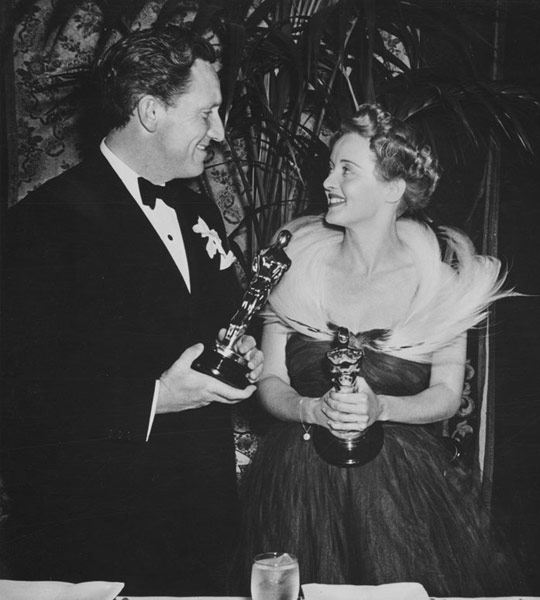
Spencer and Bette - and rather a lot of feathers
Spencer Tracy took Best Actor (again), this time for Boys Town (one of my Dad's favourites!). Best Actress went to Bette Davis for Jezebel.

The other big winner was The Adventures of Robin Hood which took a couple of technical awards and Best Score for Erich Korngold - for what is generally regarded to be one of the great film scores of all time!


Best Song:

Nothing else on the list (apart from Jeepers Creepers!) rings any bells and this one's a classic, so it's probably a worthy winner. From The Big Broadcast of 1938 (which I've just found on Youtube so I'm going to have to check it out!) here's Bob Hope and Shirley Ross with "Thanks for the Memory":


What We Could/Should Have Been Watching:

Damn you Capra - Can't take it with you?
Well give it to me then!
I like Capra. I like You Can't Take It With You. But I like at least four other Capra films better - and there are also some absolute classics on the Best Picture list this year. I can think of three that probably deserve the award more (just as Mr Deeds Goes To Town did a few years earlier....)

Grand Illusion is now considered to be one of the greatest films ever made, certainly one of the best French films ever. But it was probably a little too French for 30s Hollywood.

Pygmalion is also a really good film. Its musical remake won the Oscar, so I suppose we can overlook this one. But it's a shame more people aren't aware of the original non-singing Eliza Doolittle!

Really though, the Oscar should have gone to The Adventures of Robin Hood. In Technicolor! With Errol Flynn! And generally considered one of the greatest swash-bucklers of all time. Yep, sorry Frank. Robin Hood was robbed!


Our Verdict:

The wonderful Lionel Barrymore!
This is a really lovely film - and a joy to watch. Even though I think it shouldn't have won, I still really enjoyed watching it again. It's a film that is very much of its time but it still has quite a lot to say about money, politics and the American Dream that is relevant to modern audiences.

Grandpa Vanderhof (played by the always excellent Lionel B!) has all the best lines, like these ones - "When things go a little bad these days you go out and get yourself an -ism and you're in business" and "Lincoln said 'with malice towards no one and charity towards all'. Nowadays they say 'think the way I do or I'll bomb the daylights outta you'". Nothing much has changed!

James and Jean - if in doubt, dance...
Lionel B is brilliant here and totally holds the film together as the eccentric head of an eccentric family who shows kindness to all and gives everyone and everything a real chance. He plays the whole thing on crutches because his arthritis was making it difficult to walk - most of his remaining film roles are wheelchair bound (such as Mr Potter in It's A Wonderful Life).

James Stewart is fab playing the banker's son who, in many ways, is like a younger version of Grandpa - with a naive acceptance of everyone and everything. He can't see why there should be a problem with him marrying his secretary, even though she's not from a wealthy family, actually from a very unusual family and, furthermore, from the family that is scuppering his father's big business deal. I love James Stewart anyway - and this early role shows clearly what was to come over the next decade or so.

Just your average day at the Vanderhof/Sycamore house...
Polly-wolly-doodle on the harmonica - it solves everything!
The rest of the extended family are also great - including Mr Poppins who quits his accounting job on a whim to make his toys because Grandpa invites him to do so, Dad and the ice man making fireworks in the cellar, Mother writing plays because they got given a typewriter one day by mistake, and sister Essie dancing all the time, with her xylophone-playing husband and her Russian dance teacher.

The characters and the situations are completely wacky and over-the-top - but the writing and acting really aren't. It works as a heartwarming comedy drama, with some funny scenes and set pieces, but ultimately a good story with nice resolution and something decent and worthwhile to say.

Grandpa, for all his determination and eccentricities, puts the needs of his family first and agrees to sell the house - only for everything to turn out right in the end when fat cat Kirby realises what he's missing out on over a rousing duet of Polly-wolly-doodle on the harmonica.

And why not!

The Life Of Emile Zola 1937

The Film:

A bio-pic won for the second year running. But Florenz Ziegfeld and Emile Zola don't really have a great deal else in common (except both their surnames begin with Z and have led to the only two winners to have a Z in their title!). I knew very little about the film before watching it - except that it would be my film of choice if there was ever a Best Picture Oscars round on Pointless!

The film itself has come under quite a lot of scrutiny in recent years as one of several from the era that are alleged to have been watered down in order to avoid offending Hitler, and there for be able to be sold to Nazi Germany. The facts of the case that the film dramatizes make it very clear that anti-semitism played a significant part. But this barely gets even hinted at - and the word "Jew" doesn't appear at all. Modern theories suggest that Hays and Breen (of Hays Code infamy) were clearly behind it all - with Jewish film-makers such as Jack Warner caught in the middle of the whole thing. As with last week, there's a whole other film to be made there....

It was proving a bit tricky to find a Region 2 DVD out there for less than about £20 - but then I found several copies of the film on Youtube. This seemed to be the best - you need to go to part two for the last half hour:


The Ceremony:

The 10th Academy Awards ceremony was postponed from March 3rd to March 10th 1938, because of the Los Angeles flood. Yet again, it was held at the Biltmore.

This was the last year for the categories "Dance Direction" and "Assistant Director" - and the first year that a colour film (A Star Is Born) was nominated for Best Picture.

It was hosted by Bob Burns who was a big radio comedy star at the time - most famous for playing an instrument he invented himself which he called the Bazooka. The wonders of Youtube bring us this little explanation:


Other Notable Winners That Night:

For the third year running Best Picture didn't win Best Director - that went to Leo McCarey for the Cary Grant comedy The Awful Truth. (Leo McCarey will be back again in a few years' time....)

Luise Rainer became the first person to win consecutive acting Oscars, alongside Spencer Tracey
Janet Gaynor (especially for Andy) -
blazing a trail for Judy, Barbra and Gaga!
 (who would repeat the feat the following year). It's generally accepted that Rainer was a bit more deserving this year than last - she plays a very dramatic role in a dramatic film (alongside Paul Muni again - there were definitely fewer actors out there back then, and they made a great many more films in a shorter space of time!)

A Star is Born won "Best Story" (the equivalent of Original Screenplay) - this was clearly well deserved as the film is currently being remade yet again - after Janet Gaynor we got Judy Garland, Barbra Streisand and now Lady Gaga!


Best Song:

We get a bit of Bing singing Best Song this year - Sweet Leilani from Waikiki Wedding. Hindsight suggests strongly that Gershwin was robbed - he was nominated posthumously for "They Can't Take That Away From Me". Maybe people wanted a bit of a break from Fred and Ginger?


What We Could/Should Have Been Watching:

Another excuse for a Kate pic - this time with Ginger!
There are some big films on the list, several of which I've seen before - personal favourites are Stage Door (with Kate and Ginger being fab in New York), One Hundred Men and a Girl (my other favourite Deanna Durbin film) and the aforementioned A Star Is Born. But that's because they are the sort of films I like! Also up there are Lost Horizon and Captains Courageous among others.

I think I'd rather have been watching A Star Is Born. But I've seen that already - and there's no way I would have watched Emile Zola if it hadn't won the award.


Our Verdict:

 I went into this with no preconceptions or expectations - other than that I presumed the whole thing would be well acted (or at least Zola and Dreyfus).

After a bit more hair dye and a few trims for the opening scene.
I was drawn into the story pretty much straight away. The film was essentially in three parts. The first told the main part of Zola's life story - from being a struggling writer, to meeting Nana and writing Nana and becoming notorious and famous and rich. It went at a fair pace for about half an hour - with ever growing and whitening beard - and left him feeling content and ready to settle down to a nice life and to stop rocking the political/social boat.

(Apparently Paul Muni shot the scenes in reverse order after having grown his own beard - as Zola got younger, the beard got dyed and trimmed!)

Gid moaning. I am a Fronch Poloceman.
I was jist pissing the cofe....
The story then very abruptly moves to Dreyfus and there is no further mention of Zola for another half an hour or so, until Dreyfus is languishing in his cell. If you weren't aware of the story before watching the film it would seem like a very abrupt shift of focus - one that would have been done more subtly these days, probably cutting more between the two. However, I think it works really well. We get to know both of our main protagonists separately - and they only link together when their lives do.

Here is where all the anti-semitism is shockingly missing. You see the word "Jew" on a page and someone remarks on how someone "like that" could ever have become an officer. But everything is either implied or just missing.

Almost unrecognisable Mr Muni -
and nothing like on the poster!
Anyway - Dreyfus is set up (for no discernible reason...!) and off he goes to Devil's Island. Back to Zola who is very reluctant to get involved in anything, but eventually publishes "J'Accuse" and forces the case out in the open by being arrested for libel.

The court scene is very well done - some very clear (and still relevant) statements on the difference between being loyal to your country and loyal to whatever regime is running your country and lots about Truth and Justice. And it's ridiculous that Paul Muni didn't join Luise Rainer in winning an Oscar two years running - he is brilliant throughout!

I won't give away the complexities of the ending, but it all turns out well for Dreyfus - not so for Zola, who stands as a lesson to all of us to check our carbon monoxide detectors!

Justice! And Freedom!
There is a lovely scene where Dreyfus is released and just given his papers and left by the open door of his cell. He walks through it and then back several times almost in disbelief with a growing smile on his face. It's small, subtle and really quite brilliant. And one of the reasons Joseph Schildkraut won the Oscar.

Overall, it was a very good film and definitely worth watching. Deep and moving, well written and well acted. Sadly it's become very dated, mainly for the avoidance of the anti-semitism. But it's still a very good piece of drama.