The 30s - The Beginnings of the Oscars
With the epic technicolor dramatics of Gone With The Wind we end the first full decade of the Academy Awards (ok, technically we're talking 12 years and 13 films, but the first three needed to be tagged on somewhere!).
We began with the end of the Silent era and ended with the beginnings of mega-budget Technicolor blockbusters - a decade of many changes....
When we started I had seen three of these films before (the two Capras and Gone With the Wind). The other ten have varied from just being "historically interesting" to being surprisingly compelling and, in a couple of cases, really quite brilliant.
My Top Ten (as they stand today!) is as follows:
Film of the Decade!
1. Grand Hotel
2. Gone With The Wind
3. It Happened One Night
4. Sunrise
5. Mutiny On The Bounty (that one surprised me!)
6. You Can't Take It With You
7. All Quiet On The Western Front
8. The Life Of Emile Zola
9. Cimarron
10. Wings
(the other three are mentioned below.....)
Here's my Awards of the decade. Apart from the "non-winners" category, only the Best Picture winning films were eligible. Best Picture
Nominees:
Sunrise
Grand Hotel
It Happened One Night
Mutiny on the Bounty
Gone With The Wind
And the winner is.....
Grand Hotel - it's the one that I wanted to watch again, it had great performances and a cracking story. I loved it!
Best Director Nominees: Frank Capra (It Happened One Night, You Can't Take It With You) Lewis Milestone (All Quiet On The Western Front) Frank Lloyd (Cavalcade, Mutiny On The Bounty) FW Murnau (Sunrise) Victor Fleming (Gone With The Wind)
And the winner is.....
Frank Capra - of course. He was nominated five times as Director in the 30s and he won three of them. I know he's a bit marmite for film buffs, but I really like him!
Best Actor
Nominees: Clark Gable (It Happened One Night, Mutiny on the Bounty, Gone With The Wind) John Barrymore (Grand Hotel) Lionel Barrymore (Grand Hotel, You Can't Take It With You) Lew Ayres (All Quiet On The Western Front) Paul Muni (The Life Of Emile Zola) And the winner is.....
Lionel Barrymore - with an honourable mention to his fabulous brother! Clark Gable is everywhere but, as Andy says, he generally just plays Clark Gable in different settings. LB on the other hand is totally different in his two roles here, and completely brilliant in both. Best Actress
Nominees: Janet Gaynor (Sunrise) Joan Crawford (Grand Hotel) Claudette Colbert (It Happened One Night) Vivien Leigh (Gone With The Wind) Olivia de Havilland (Gone With The Wind) And the winner is.....
It took the Academy 14 more years to give Joan an Oscar!
Joan Crawford AND Vivien Leigh - because ties have happened before, and they are so different and both fab. (Andy would have gone for Janet Gaynor btw). If I really had to I'd probably have to say Joan Crawford, mainly because I was really surprised at how good she was - especially as most of my reference points for her are Mommie-Dearest-era melodrama. But Vivien Leigh as Scarlett O'Hara is also an all time classic. Best Non-Winning Picture Nominees:
42nd Street
Top Hat
Mr Deeds Goes To Town
A Star Is Born
Mr Smith Goes To Washington
And the winner is.....
42nd Street - mainly because of what it lost out to (Cavalcade) and because it would have meant that a properly good Broadway-based musical would have won an Oscar in a decade where there were some great ones (and two not so great winners!)
Hooray for Fanny Brice!
Worst Picture Nominees:
The Broadway Melody
Cavalcade
The Great Ziegfeld
Just three duds - and I'm not sure I can separate them. The Broadway Melody suffered from the time in which it was made (and was just about redeemed by Bessie Love!), Cavalcade was just too stiff and wooden and weirdly paced (and was just about redeemed by Fanny Bridges!). And The Great Ziegfeld was an hour too long with a story too slight (and was just about redeemed by Fanny Brice!)
We've arrived at the first absolutely mega winner - there probably isn't a great deal to say about this film that hasn't already been said. But I'll give it a go.
It was the first winner in colour (and there wouldn't be another one for over a decade!) and it remains the longest film to win Best Picture - clocking in at 221 minutes (or 238 including the Overture, Interval and Exit music). It was one of the most expensive films ever made at the time and, with adjustments for inflation, remains to this day the biggest box office hit of all time.
It was nominated for 13 awards and won 8 of them - a record at the time, and this in a year with an incredibly strong field!
It is still regarded by many as a masterpiece today. Although it is criticised by some for its portrayal of African Americans, it is still praised by others for the prominence it gave to African American actors (see below).
It's important today to remember that this is a film made nearly 80 years ago about events that took place nearly 80 years before then. We're in the 2010s watching a 1930s take on the 1860s. Which is a bit difficult to get your head around..... The Ceremony:
Bob begins his longstanding relationship with Oscar
The ceremony took place on February 29th 1940 at the Coconut Grove. New categories this year included Special Effects and the splitting of Cinematography into Colour and Black and White.
It was the first time an award was given posthumously (to Sidney Howard for his Gone With The Wind Screenplay) and the first nomination and win for an African American - and the first time attendance at the ceremony wasn't all white (see below!).
It was also the first Ceremony to be hosted by Bob Hope who went on to host it a record nineteen times - the last one being in 1978. There will be a lot more of him in this blog no doubt.....
Other Notable Winners That Night:
Hattie and her Oscar (the Supporting categories only got a plaque in those days!)
Best Actress went to Vivien Leigh - although apparently it was a close-run thing with Bette Davis. Best Actor was Robert Donat for Goodbye Mr Chips. People tend to think Clark Gable was pipped to it, but it was actually a shock to many on the night that James Stewart didn't win for Mr Smith Goes To Washington (and having seen all three performances, I'm inclined to agree!) But the most notable winner of the night had to be Hattie McDaniel. Aside from the fact that she was quite brilliant as Mammy in Gone With The Wind and thoroughly deserved the award on merit, it was a significant move to recognise her in this way, considering the social and political climate in the US at the time. A year earlier McDaniel and the other African American actors in the film had not been allowed to attend the premiere in Georgia because of segregation laws. The Academy had to get special permission for her to attend the Awards Ceremony, because the Coconut Grove was also segregated. She was allowed to attend but was placed at a separate table near the back of the room with just her escort - although some of the film's production team moved to sit with them. It seems like a different world - but it's arguable that we haven't come as far as we think since then, which the #Oscarsowhite controversy a couple of years ago highlighted. Best Song:
It really was a vintage year wasn't it? It doesn't even matter what else was nominated in this category (not a lot, actually!) - this needs no introduction to anyone pretty much anywhere on the planet:
What We Could/Should Have Been Watching:
It's ok Jimmy - we'll see you again next year!
I don't think there is any doubt that the Best Film won this one. It ticks all the boxes needed and is still well regarded today.
However - the field was very strong. On any other year there would have been several other strong contenders (who would have beaten last year's and probably next year's winners quite easily). I've seen most of these and they are all well regarded today. The list is as follows:
Dark Victory (Bette acting her socks off)
Goodbye Mr Chips (Heartwarming Oscar fodder)
Love Affair (the better version of An Affair to Remember)
Mr Smith Goes To Washington (Frank and Jimmy at their best - a winner in another year!)
Ninochka (Garbo laughs!)
Of Mice And Men (great version of Steinbeck classic)
Stagecoach (classic Western)
Wuthering Heights (Olivier at his moodiest)
Wizard of Oz (nuff said!) Our Verdict: Well - it's about the fifth or sixth time I've seen this film. Second time for Andy. I've always liked it, probably more than it really deserves. It is flawed - possibly in its politics (some of the title cards are a bit too glorifying - and the jury is out on the possible racist slant of some scenes), arguably in pacing (the second half drags a bit - particularly when you're sitting there waiting for people to hurry up and die!) and definitely in acting (a fair bit of wooden melodrama and a few dodgy accents). However - just look at the the thing! And remember that it was made in 1939!!! The technicolor is amazing and the cinematography is just stunning. There are some incredible crowd scenes and great special effects (particularly the Atlanta burning sequence). The costumes and sets are glorious and there is some really unusual and intelligent framing of some of the intimate scenes. It may be nearly four hours - but it's four hours well spent!
The thing that struck me this time was how the whole thing was really about Scarlett's relationships - and by that I don't mean her husbands (except one), but in a wider sense. Everything revolves around her inability to focus on what is actually good for her - she is blinded by her own ideas of what her life should be. Some of this makes her strong and likeable. A lot of it makes her selfish and bitchy. And in the best scenes it makes her vulnerable.
Ashley. Wet. And ever so slightly annoying when called out to in a Southern Accent.
Firstly there's Ashley. I have absolutely no idea why she is so smitten with Ashley for so long, but there you go! He colours every other decision she makes in her life without really doing anything except exist and be married to someone else. I don't know how far it's the character and how far it's the acting (Leslie Howard was too old and too English - he was Professor Higgins the year before!) but this is the weak link and the least believable relationship for me.
Rhett. I get it, but they were both as bad as each other!
Then there's Rhett. I know we are supposed to see this as one of the greatest love affairs in film (or something) but really the only thing he had going for him (apart from the money) was that he was clever enough to get the measure of Scarlett and stand up to her early on. There's some sort of deep down decency in him (the way he is with Melanie and with Belle at the brothel) but he's still selfish and a bit too caddish - I had a lot less time for him on this viewing. The way he talks to Scarlett has shades of what (some) modern women see today in Christian Grey. And that put me right off!
A girl should always listen to her Mammy!
Scarlett needs to pay more attention to the women in her life - they are the best relationships she's got. Right from the beginning of the story Mammy always tells her exactly what she thinks and doesn't shy away from telling her off when she is behaving like a spoilt brat. And she continues to do this right through the rest of the story. Generally Scarlett takes the scoldings - although she doesn't always act on them - and there is a lot of love and respect between the two. Hattie McDaniel's performance in this role absolutely nails it and makes Mammy one of the strongest characters in the story - as well as the wisest, with the most common sense. She also stands up for herself and commands respect. All very significant.
Poor Melanie.......
And then we come to Melanie. She's Andy's favourite character. I have to admit that it takes the first hour to warm to her. I find her a bit too good and sickly sweet at the beginning of the story. When she gives her wedding ring away at the fundraiser it's all a bit vomit-inducing. However, she wins me round as she and Scarlett get closer and it becomes more apparent (to this viewer anyway!) that she knows exactly why Scarlett is hanging around her so much, and she deals with the whole thing with kindness and dignity. She is the strong one - she is far too good for Ashley!
After all, tomorrow is another day......
Scarlett should have listened to the women in her life a little more - and things wouldn't have been so complicated. However, Scarlett's real true love is revealed in the last few lines of dialogue in the film. Everyone remembers "Frankly my dear, I don't give a damn!" - but it's what comes next that really matters. Some viewers apparently were miffed that the story didn't end properly or that there wasn't a sequel. But it was a great ending. The only thing Scarlett truly loved, that she would do anything for, risk her life and work her fingers to the bone (literally) was Tara. This was her problem all along, and what makes her such a great character - she's a 21st Century feminist businesswoman trapped in the Deep South in the 1860s!
This, like our previous Capra winner, is another film that I know pretty well. It comes from being an unashamed Capra fan! Having said that, I still find it surprising that this was one of his Best Picture winners - when Mr Deeds, Mr Smith and George Bailey all lost out!
However - it's a good 'un and it gives a nice slice of Hollywood's version of American 30s family life. It's based on a Pulitzer Prize-winning play and is very much an ensemble piece (Lionel Barrymore plays the lead - but he's only just the lead....). The wider cast is unusually large for a film of its style.
It's the second Capra film to win Best Picture and the third win for Capra as Best Director, all within the space of five years. He had a good decade - even though his most famous and successful film is still another eight years away. It's the first Capra film to star James Stewart (unfortunately we only get to see him once more on this challenge - in heavy make up!) and it also has an early appearance by Ann Miller, dancing her way through the film as she always did (unfortunately this is the only time we'll see her!)
The Ceremony:
It was held at the Biltmore again - on 23rd February 1939. There was no official host that year (no
Yes, it's Shirley again - so what, it's the 30s!
idea why!) and all radio coverage was banned (again, no idea why!).
It was the first year to feature a Foreign Language Film in the nominations for Best Picture (there was no separate category back then) - Renoir's Grand Illusion. It was also the second year in a row that someone won back-to-back awards. This time Spencer Tracy.
After a fair bit of outcry that Snow White and the Seven Dwarfs was snubbed the year before (and it would be a long time before Animated Features had their own category!) the film was given an honorary award - of one big Oscar and seven little ones!
Other Notable Winners That Night:
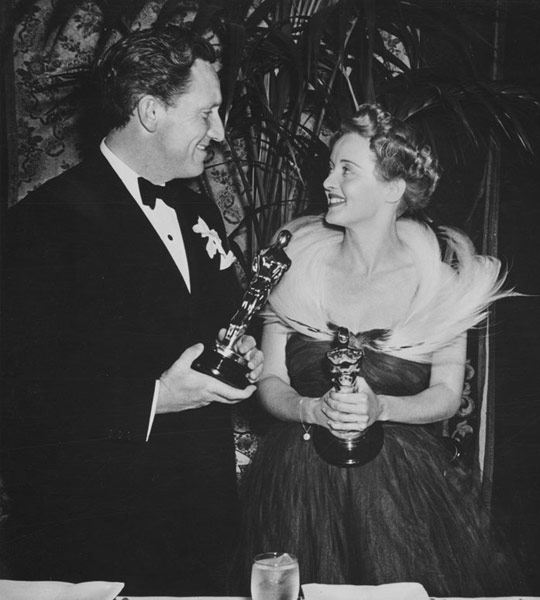
Spencer and Bette - and rather a lot of feathers
Spencer Tracy took Best Actor (again), this time for Boys Town (one of my Dad's favourites!). Best Actress went to Bette Davis for Jezebel. The other big winner was The Adventures of Robin Hood which took a couple of technical awards and Best Score for Erich Korngold - for what is generally regarded to be one of the great film scores of all time!
Best Song:
Nothing else on the list (apart from Jeepers Creepers!) rings any bells and this one's a classic, so it's probably a worthy winner. From The Big Broadcast of 1938 (which I've just found on Youtube so I'm going to have to check it out!) here's Bob Hope and Shirley Ross with "Thanks for the Memory":
What We Could/Should Have Been Watching:
Damn you Capra - Can't take it with you? Well give it to me then!
I like Capra. I like You Can't Take It With You. But I like at least four other Capra films better - and there are also some absolute classics on the Best Picture list this year. I can think of three that probably deserve the award more (just as Mr Deeds Goes To Town did a few years earlier....)
Grand Illusion is now considered to be one of the greatest films ever made, certainly one of the best French films ever. But it was probably a little too French for 30s Hollywood.
Pygmalion is also a really good film. Its musical remake won the Oscar, so I suppose we can overlook this one. But it's a shame more people aren't aware of the original non-singing Eliza Doolittle!
Really though, the Oscar should have gone to The Adventures of Robin Hood. In Technicolor! With Errol Flynn! And generally considered one of the greatest swash-bucklers of all time. Yep, sorry Frank. Robin Hood was robbed!
Our Verdict:
The wonderful Lionel Barrymore!
This is a really lovely film - and a joy to watch. Even though I think it shouldn't have won, I still really enjoyed watching it again. It's a film that is very much of its time but it still has quite a lot to say about money, politics and the American Dream that is relevant to modern audiences.
Grandpa Vanderhof (played by the always excellent Lionel B!) has all the best lines, like these ones - "When things go a little bad these days you go out and get yourself an -ism and you're in business" and "Lincoln said 'with malice towards no one and charity towards all'. Nowadays they say 'think the way I do or I'll bomb the daylights outta you'". Nothing much has changed!
James and Jean - if in doubt, dance...
Lionel B is brilliant here and totally holds the film together as the eccentric head of an eccentric family who shows kindness to all and gives everyone and everything a real chance. He plays the whole thing on crutches because his arthritis was making it difficult to walk - most of his remaining film roles are wheelchair bound (such as Mr Potter in It's A Wonderful Life).
James Stewart is fab playing the banker's son who, in many ways, is like a younger version of Grandpa - with a naive acceptance of everyone and everything. He can't see why there should be a problem with him marrying his secretary, even though she's not from a wealthy family, actually from a very unusual family and, furthermore, from the family that is scuppering his father's big business deal. I love James Stewart anyway - and this early role shows clearly what was to come over the next decade or so.
Just your average day at the Vanderhof/Sycamore house...
Polly-wolly-doodle on the harmonica - it solves everything!
The rest of the extended family are also great - including Mr Poppins who quits his accounting job on a whim to make his toys because Grandpa invites him to do so, Dad and the ice man making fireworks in the cellar, Mother writing plays because they got given a typewriter one day by mistake, and sister Essie dancing all the time, with her xylophone-playing husband and her Russian dance teacher.
The characters and the situations are completely wacky and over-the-top - but the writing and acting really aren't. It works as a heartwarming comedy drama, with some funny scenes and set pieces, but ultimately a good story with nice resolution and something decent and worthwhile to say.
Grandpa, for all his determination and eccentricities, puts the needs of his family first and agrees to sell the house - only for everything to turn out right in the end when fat cat Kirby realises what he's missing out on over a rousing duet of Polly-wolly-doodle on the harmonica.
A bio-pic won for the second year running. But Florenz Ziegfeld and Emile Zola don't really have a great deal else in common (except both their surnames begin with Z and have led to the only two winners to have a Z in their title!). I knew very little about the film before watching it - except that it would be my film of choice if there was ever a Best Picture Oscars round on Pointless!
The film itself has come under quite a lot of scrutiny in recent years as one of several from the era that are alleged to have been watered down in order to avoid offending Hitler, and there for be able to be sold to Nazi Germany. The facts of the case that the film dramatizes make it very clear that anti-semitism played a significant part. But this barely gets even hinted at - and the word "Jew" doesn't appear at all. Modern theories suggest that Hays and Breen (of Hays Code infamy) were clearly behind it all - with Jewish film-makers such as Jack Warner caught in the middle of the whole thing. As with last week, there's a whole other film to be made there....
It was proving a bit tricky to find a Region 2 DVD out there for less than about £20 - but then I found several copies of the film on Youtube. This seemed to be the best - you need to go to part two for the last half hour:
The Ceremony:
The 10th Academy Awards ceremony was postponed from March 3rd to March 10th 1938, because of the Los Angeles flood. Yet again, it was held at the Biltmore.
This was the last year for the categories "Dance Direction" and "Assistant Director" - and the first year that a colour film (A Star Is Born) was nominated for Best Picture.
It was hosted by Bob Burns who was a big radio comedy star at the time - most famous for playing an instrument he invented himself which he called the Bazooka. The wonders of Youtube bring us this little explanation:
Other Notable Winners That Night: For the third year running Best Picture didn't win Best Director - that went to Leo McCarey for the Cary Grant comedy The Awful Truth. (Leo McCarey will be back again in a few years' time....) Luise Rainer became the first person to win consecutive acting Oscars, alongside Spencer Tracey
Janet Gaynor (especially for Andy) - blazing a trail for Judy, Barbra and Gaga!
(who would repeat the feat the following year). It's generally accepted that Rainer was a bit more deserving this year than last - she plays a very dramatic role in a dramatic film (alongside Paul Muni again - there were definitely fewer actors out there back then, and they made a great many more films in a shorter space of time!) A Star is Born won "Best Story" (the equivalent of Original Screenplay) - this was clearly well deserved as the film is currently being remade yet again - after Janet Gaynor we got Judy Garland, Barbra Streisand and now Lady Gaga! Best Song:
We get a bit of Bing singing Best Song this year - Sweet Leilani from Waikiki Wedding. Hindsight suggests strongly that Gershwin was robbed - he was nominated posthumously for "They Can't Take That Away From Me". Maybe people wanted a bit of a break from Fred and Ginger?
What We Could/Should Have Been Watching:
Another excuse for a Kate pic - this time with Ginger!
There are some big films on the list, several of which I've seen before - personal favourites are Stage Door (with Kate and Ginger being fab in New York), One Hundred Men and a Girl (my other favourite Deanna Durbin film) and the aforementioned A Star Is Born. But that's because they are the sort of films I like! Also up there are Lost Horizon and Captains Courageous among others.
I think I'd rather have been watching A Star Is Born. But I've seen that already - and there's no way I would have watched Emile Zola if it hadn't won the award.
Our Verdict:
I went into this with no preconceptions or expectations - other than that I presumed the whole thing would be well acted (or at least Zola and Dreyfus).
After a bit more hair dye and a few trims for the opening scene.
I was drawn into the story pretty much straight away. The film was essentially in three parts. The first told the main part of Zola's life story - from being a struggling writer, to meeting Nana and writing Nana and becoming notorious and famous and rich. It went at a fair pace for about half an hour - with ever growing and whitening beard - and left him feeling content and ready to settle down to a nice life and to stop rocking the political/social boat.
(Apparently Paul Muni shot the scenes in reverse order after having grown his own beard - as Zola got younger, the beard got dyed and trimmed!)
Gid moaning. I am a Fronch Poloceman. I was jist pissing the cofe....
The story then very abruptly moves to Dreyfus and there is no further mention of Zola for another half an hour or so, until Dreyfus is languishing in his cell. If you weren't aware of the story before watching the film it would seem like a very abrupt shift of focus - one that would have been done more subtly these days, probably cutting more between the two. However, I think it works really well. We get to know both of our main protagonists separately - and they only link together when their lives do.
Here is where all the anti-semitism is shockingly missing. You see the word "Jew" on a page and someone remarks on how someone "like that" could ever have become an officer. But everything is either implied or just missing.
Almost unrecognisable Mr Muni - and nothing like on the poster!
Anyway - Dreyfus is set up (for no discernible reason...!) and off he goes to Devil's Island. Back to Zola who is very reluctant to get involved in anything, but eventually publishes "J'Accuse" and forces the case out in the open by being arrested for libel.
The court scene is very well done - some very clear (and still relevant) statements on the difference between being loyal to your country and loyal to whatever regime is running your country and lots about Truth and Justice. And it's ridiculous that Paul Muni didn't join Luise Rainer in winning an Oscar two years running - he is brilliant throughout!
I won't give away the complexities of the ending, but it all turns out well for Dreyfus - not so for Zola, who stands as a lesson to all of us to check our carbon monoxide detectors!
Justice! And Freedom!
There is a lovely scene where Dreyfus is released and just given his papers and left by the open door of his cell. He walks through it and then back several times almost in disbelief with a growing smile on his face. It's small, subtle and really quite brilliant. And one of the reasons Joseph Schildkraut won the Oscar.
Overall, it was a very good film and definitely worth watching. Deep and moving, well written and well acted. Sadly it's become very dated, mainly for the avoidance of the anti-semitism. But it's still a very good piece of drama.
The Film:
It's a musical. An MGM Musical. And it's also a bio-pic of someone I already know a bit about (the first bio-pic to win the award). It's not a film I had seen, although I knew the (in)famous "Pretty Girl Is Like A Melody" sequence from That's Entertainment. All the signs point to this being my sort of film....
It was very heavily promoted by MGM, who threw lots of money at the production as well as the promotion - and it became a massive box office hit.
Getting the project off the ground was apparently quite a feat in itself. Ziegfeld himself had only been dead a couple of years and his wife (Billie Burke, played by Myrna Loy) and many, many of his mistresses and business associates were nearly all still around, each with a different take on what really went on.
Billie Burke sold the rights to her story in order to pay off Ziegfeld's debts - but she blocked the casting of Marilyn Miller, who then threatened to sue if she was mentioned at all in the film (although she's quite obviously the character "Sally Manners" - who has a much smaller part to play than you would expect....). So the story behind the story is fascinating in itself, and the very large production numbers are infamously spectacular. Time to settle down with the popcorn....
The Ceremony:
Still very much a gala dinner rather than a performance!
The Awards were held at The Biltmore again, on the same weekend of the year as last year - 4th March 1937. They were definitely starting to take shape as a real event by now (which was the 9th ceremony) and the evening included music from the Victor Young and his orchestra - he was becoming a big name in musical accompaniment in Hollywood and is probably most famous for working with Bing Crosby.
The main big change this year was the introduction of Best Supporting Actor / Actress categories - long overdue, since Lionel Barrymore won an Oscar for a decidedly supporting role back in 1931. The triple nominations for the actors in Mutiny On The Bounty the previous year was probably the main thing that prompted the change for this year. These categories have been awarded every year since and have been really important in highlighting lesser known actors and films - particularly comic actors and character actors.
Other Notable Winners That Night:
Frank Capra, Luise Rainer and Paul Muni - Best Director,
Best Actress and Best Actor
Frank Capra won Best Director for the second time in three years - this time for Mr Deeds Goes To Town (see below for my verdict on that film!).
Luise Rainer won Best Actress for playing Ziegfeld's first wife, Anna Held in The Great Ziegfeld. She's a German actress, playing a French actress speaking in English. She emotes a lot - more, or less, successfully than Garbo in Grand Hotel (depending on your point of view) but with a similar amount of moping about in her room on the telephone.
Paul Muni won his only award (from several nominations) for playing Louis Pasteur. He's playing Emile Zola in our next film, so I'll say more about him then.
The first Supporting awards went to Walter Brennan (one of his three - matched only by Nicholson and Day Lewis!) and Gale Sondergaard (again, more of her next time).
Here's a nice bit of (clearly staged) film of Luise Rainer receiving her award:
Best Song:
A lot of songs nominated this year, including Pennies from Heaven and I've Got You Under My Skin, which have both stood the test of time. Nothing from Ziegfeld, as none of them were "original". An absolute classic won again this year. "The Way You Look Tonight" from Swing Time. Take it away Fred:
What We Could/Should Have Been Watching:
Don't worry Gary - your time will come. And at least you didn't
get killed after five minutes in this one!
I do like my musicals but I think it's going to be another 25 films or so until one that I really love wins Best Picture. The Great Ziegfeld would not have been my pick for this year.
There are quite a few big hitters on the list this year (and one of my favourite Deanna Durbin films - Three Smart Girls!) but one stands out clearly for me. The award should have gone to Mr Deeds Goes To Town. Hands down. Absolutely. Watch me beat down anyone who argues otherwise....
Yes, I'm an unashamed Capra fan, so I may be a little bit biased. But I watched this film again a couple of months ago and it is still incredibly watchable, beautifully filmed, scripted, acted etc - and massively relevant to the modern world. Longfellow Deeds' speech in the courtroom near the end reminded me of Jeremy Corbyn and Bernie Sanders, and made me wish that every Trump voter had been forced to watch this on a loop in the lead up to the elections. And when you think about what was going on in the US in the mid-30s, and what happened to left-leaning Hollywood a few years later, it is a real shame that this lost out to the nostalgic excesses of Ziegfeld.
Our Verdict:
Pretty girls, just like melodies - great overblown excessive ones!
I don't really know where to start with this one. I was quite looking forward to a good old fancy 30s musical - but overall the whole thing was a bit of a let down.
The film was very lovely to look at, the dialogue was far less cheesy than I thought it would be, and the acting was really rather impressive. I particularly liked William Powell in the lead. He did a very good job at playing someone who (and here's part of the problem) ultimately wasn't very likeable or particularly interesting.
Not quite the same impact as the NHS sequence at the
2012 Olympics - but impressive, nonetheless!
The big set pieces were great fun (I liked them more than Andy did - but I expected that) and they had learned a lot since Broadway Melody about how to film very stage-bound numbers. The "Pretty Girl Is Like A Melody" number is the one I knew and it looks great. There were also a couple of others - including one with loads of beds, another with some trained dogs (see clip below), and a great bit of pre-scarecrow Ray Bolger throwing himself across the stage.
The problem is, there weren't quite enough of them compared to how much time was spent on the overall story. We were about an hour in before we got the first one. And an hour in was only a third of the way through the film.
This was a looooong film. Far too long for such a slight story - he makes money, he loses it, he finds women, he loses them, he puts on shows, he dies. That's the story. About a quarter of it was singing and dancing. And I can't really tell you what took up all the time for the rest of it.
Thank you Fanny Brice!!
The second billed name is Myrna Loy and she doesn't turn up for over two hours - and then is criminally under-used (although the real Billie Burke may have had something to do with that....). Frank Morgan is great as Ziegfeld's friend/rival but the character seems to run out of steam half way through. (Lots of Oz interest here though - with Ray Bolger, Frank Morgan and the real Billie Burke all going to appear in the Wizard of Oz in a few years time...)
The absolute saving grace of the whole film is the appearance of Fanny Brice playing herself (although she's billed as Fannie Brice). I've seen Funny Girl a few times but I'd never seen any footage of the real thing. She is a breath of fresh air at just the right moment and gets a nice chance to show off her singing and comedic talents. And all credit to Barbra Streisand who did such a good impression of her! I only wish there had been more Fanny Brice and a lot less faffing around with everything else.
Weirdly, this film appears to have inspired a lot of gifs!
I think I had two main problems with The Great Ziegfeld. One, it was about an hour too long. Other three hour plus films that spring to mind are Gone With The Wind, Giant and The Godfather. They were all big family sagas with plenty of action and a lot to say. This film really wasn't.
Secondly, it wasn't really sure if it was a musical film or just a film about musicals. It felt like a drama with some set pieces thrown in (which neither 42nd Street or even The Broadway Melody really did) - and it didn't quite live up to the trailers because of it.
I'm glad I've seen it. But I won't rush to see it again.
This is a story I know pretty well (most people do, I suppose?) but I've never seen this version of it. I vaguely remember not being interested in the Marlon Brando version when it was on - probably on a Sunday afternoon - when I was much younger. (To be fair, if there weren't any children in it, people didn't sing and/or dance and there was no magic going on I wasn't really interested until I was about 12 or 13.)
It was a $2 million epic that received multiple nominations (although it only actually won one award) and was a big box office smash. And the casting of the previous two Best Actor winners is pretty impressive.
But - how far does it stand the test of time? Does it still look technically impressive at all? Does the acting stand up? Are the historical inaccuracies too obvious and distracting? Are there going to be too many culturally inappropriate natives to deal with? And will it be worth two and a quarter hours to find out......
The Ceremony:
The 8th Awards were held on March 5th 1936 at The Biltmore and were presented by Frank Capra - which was quite fitting after him cleaning up the awards the previous year.
The only new award this year was for Dance Direction - an award that only lasted for a few years, which says something about the changing emphasis in Hollywood. It was the second and last time that "write-in" nominations were allowed - and Cinematography was won via that method. It is also the only year (to date) where three of the Best Actor nominations were for the same film, and this may have been a key factor in introducing Supporting categories the following year.
Most notably, this was the first year that the awards themselves were referred to as Oscars!
One hell of a line-up at the ceremony - Frank Capra, DW Griffith, Jean Hersholt,
Henry B Walthall, Frank Lloyd, Cecil B de Mille, Donald Crisp.
And I've found a little bit of film too:
Other Notable Winners That Night:
Bette and Victor
Despite all the nominations - including the three for Best Actor - Mutiny on the Bounty only won one award (the last time so far that this has happened!)
Best Director was the first of several for John Ford, for The Informer. Victor McLaglen won Best Actor for the same film, and Bette Davis won the first of her Best Actress awards for Dangerous.
DW Griffith, pictured with the dignitaries above, won an honorary award. His major works were completed before the Academy Awards started so this was a way of recognising how important he was to the development of motion pictures. His most famous work, Birth of a Nation, was in 1915 and is really impressive as a piece of film making (if a bit on the long side!) but now more famous for some quite nauseating racism - some horrible blackface, and the KKK riding in as the heroes! All that aside, he probably still deserved his award for "invaluable initiative and lasting contributions to the progress of the motion picture arts".
Best Song:
This is clearly now going to become a thing on this blog, so I might as well give it its own sub-heading. This year Fred and Ginger lost out twice ("Cheek to Cheek" and "Lovely To Look At") to the epic that is the Lullaby of Broadway, from Gold Diggers of 1935. The whole sequence from the film lasts about 13 minutes - this is just some of it:
What We Could/Should Have Been Watching:
He gets everywhere - and can probably sing better than Russell Crowe!
The list is quite an impressive one again - including the sequel to a previous winner (Broadway Melody of 1936), the version of David Copperfield with WC Fields, a swashbuckling Errol Flynn (Captain Blood), and one of several versions of Les Miserables (where, thankfully, Charles Laughton doesn't have to sing Stars!). It also includes Top Hat which I love (unsurprisingly).
But I do think that the Best Film won again this time!
Our Verdict:
Seamen's rights, or the lure of Tahitian ladies?
You decide!
I wasn't expecting to do much more than just appreciate this film - big blockbusting action films are not really my thing. They have to be really good for me to like them. However, I was very pleasantly surprised! Right from the opening scenes I was hooked in and I stayed hooked for the whole film.
Considering that Cavalcade - also directed by Frank Lloyd - was only two years earlier, both the technical advances and the whole way that the story was filmed an edited were way beyond anything in that film. And I think that is what underpins the whole film. Along with great acting, impressive pacing, good use of humour, great cinematography. In short, I really liked it!
Gable sans 'tache - more than a hint
of Clooney about him?
Firstly, the story. I've never really been too fussed about this era of history, particularly the whole naval "Rule Britannia" for-King-and-country-ness of the sort of films made about it. With my Sociology hat on I'm far more interested in what happened after they got to Pitcairn (and how it all led to the sex abuse trials in 2004) than who strung who up to get there in the first place. Having said that, the story was told really well. The first ten minutes or so when they are all preparing for the voyage (and the entrance of the Captain!) is really well done - with real humour and a light touch that cleverly introduces the main characters. By the time they set sail I was ready to go with them.
From that point onwards the story kept up its pace really well. There was never too much time spent dwelling on long speeches - and even the action sequences (which were impressive - and very wet!) were short and to the point before moving on to the next bit of the story. The torture inflicted on board (the film portrays it as such) is shown unflinchingly but without gore and the mutineers are shown to be just as bloodthirsty. And I never got bored!
Suspicious cheese - thankfully, absolutely none of it on
display in the acting.
Secondly, the acting. Clark Gable was playing Clark Gable (he usually does) but I was totally convinced that he was Fletcher Christian and that he came from Cumberland, even with his unmistakably American accent. Even though the tone of the story paints Christian as too much of a hero, Gable manages to hint at a darker side by the end of the film - I could well believe that he was more interested in getting back to some Tahitian women than he was in securing justice for the crew.
Smug, superior and nasty - all in one look!
Charles Laughton (who seems to be in everything in the mid-30s!) is brilliant as Bligh. His face helps, as it does in his other famous roles, but his actual acting is also pretty impressive. He presents Bligh as a thoroughly unpleasant piece of work, but there is a little bit of pathos in there - in the scene where his fellow officers refuse to eat his tainted cheese, when he's adrift and saving his men and in the court martial where he simultaneously wins and loses. Historians have since shifted the balance of blame firmly from Bligh to Christian, but Laughton's Bligh does what he was written to do.
The third in the nominated trinity is Franchot Tone playing a fictional mashup of officers who serves as our viewpoint for the first part of the film and then as the balancing conscience (and ultimate hero) for the second half. Nice acting - and very clever writing!
Ok, so this photo is gratuitous. But so what!
The fact that the relevant parts of the film were actually shot in and around Tahiti adds something to the overall effect. And the special effects are far less "ship in a bathtub" than I was expecting. Despite a fair bit of the budget going on the stars, the rest of it was well spent.
Mutiny On The Bounty has unexpectedly summed up exactly why this Oscar Challenge is proving to be a great idea. Along with Cavalcade and Cimarron this is a film that I would never in a million years have sat down to watch otherwise - and it's by far the best of the three!
Frank Lloyd's grandson has a great Youtube channel with lots of his films on it (it's where we found Cavalcade) including this short "making of":


 Frank Capra (It Happened One Night, You Can't Take It With You)